Translate

Wednesday, February 22, 2023

Air

 New Mexico is famous for its wild landscapes and scenery, even as many people fear its wildlife, wildfires and lawlessness. But everything has a balance and concepts such as right and wrong are purely human inventions.

 The burns from prior forest fires can still be clearly seen at Romero, as the brooding clouds threaten snow in the background. This area also has scars of its past use as a dump. Also, the scraggly, old trees show the effects of a rising soil overburden, which prevents new seedling from growing, dooming the cottonwood forest. The overall effect is ethereal, beautiful, and also poignant.
The sunsets are also famous, especially as the windy season begins. Pollutants, smoke from other states, and dust collect in the air above the central Rio Grande basin and swirl in basically a giant bowl, creating billowing skies of illusion, filled with imagined smoke and fire.
The Corrales Bosque seems to be a thick growth of trees, but is more like a patchwork of influences and history that can be seen it the plant growth. The plants have been cleared many times for many reason, and they grow back in unique ways. Here, the willows begin to replace bare earth as succession begins again. The patches of snow insulate and water the dirt below it, laying the foundations for the plants that follow.
In the Harvey Jones channel, a pipit begins catching the insects as they emerge from the mud. The soil here is laced with artificial sweetener from the effluent of over one hundred thousand people in Rio Rancho, as well as seeds and organisms brought from other landscape projects far away. The results are wild, and unpredictable. Fortuitous, or perilous in equal measure, the outcomes will not be seen by this, or even the next generation of humans who live here.
In any change, there are winners and losers. This is how most people also measure the effects of the passage of time. What is clear is that the crows are well along the way of understanding the effects of humans on their landscape and their numbers are thriving as they adapt to new food sources such as french fries, road kill, and landfill. The flocks are slowly moving north into Corrales as they forage in new areas each evening.
Grackles are usually seen in strip mall parking lots along Rio Rancho in the summer. Their range has expanded into the Southwest, since they days when they were introduced into Mexico by the Aztecs for their feathers. This flock is eating mistletoe, something I have never heard of before now. They feed in large numbers in agricultural fields, because they are usually ground foragers.
Bluebirds appear in New Mexico during the winter as they head south to feed on berries and the odd insect. Insects require a lot more effort to collect, but this activity makes it much easier to observe them. I used to see them under bird feeders, but I think they are after insects based on their behaviors.
Black flies and midges are not very exciting insects, but they herald the coming frenetic days of summer. They crawl from the damp. cold soil and begin breeding straight away.
In spite of all we know about ants and their crazy behaviors, there is still a lot for these eusocial insects to teach us, if we choose to look. I think these insects are out scouting for the first of the elm seeds to begin the process of rebuilding the colony. This is a very early scout.
Many birds are starting to move to locations for mating and nest building. The big raptors like the hawks and owls are already figuring out the territories. This one clearly prefers the edge of an overgrown field by Heidi's.

 The little kestrels still come and go seemingly at random as they hunt the smallest rodents. I have seen more nocturnal animals like raccoon and skunk, but they are very hard to capture on camera. The kestrels have amazing sight, but that's only useful during the day. Notice the cottonwood tree it is perched on has begun to bud.
The elms in the bosque are famous for their samaras, or seeds. Here is a picture of the flowers that form and are wind pollinated, just in time for the impressive winds of New Mexico spring this year. These flowers are edible, with a mild flavor that is pretty distinctive. Ants collect many of the mature seeds when they fall. The Siberian elms are invasive but were imported by ex-governor Clyde Tingley to reduce the wind and dust that early city dwellers found in Albuquerque. These trees have completely changed the look of the bosque, or maybe are a consequence of changes that time has done to the bosque. Further changes will follow, in time. For better or worse, or both, most likely.
 

Thursday, February 9, 2023

Grow


 Spring is the season for growing, and while we are still in winter the groundwork for growing has begun. Fields are being plowed, the cold weather plants like mustard plants are already flowering. Insects are out in the middle of the day, and birds are moving to their breeding grounds. Some are leaving, like the geese and cranes, but others are moving in, and setting up territories.

Red tailed hawks are impressive birds up close. They are also smart and can hunt in packs out of the plains on New Mexico for rabbits. Mostly, they prefer to hunt from ambush from tree perches on the field edges, like this one does. They seem to follow the movements of voles and geese.
The problem with ambush hunting is that it doesn't work if you are spotted, so most red tailed hawks look grumpy when they are being photographed and singled out by people. This blur is a picture of a solitary crow harassing a hunting bald eagle. The crow is mostly drawing attention to the larger bird, and also reducing it's hunting success, which it will remember next time it comes over Corrales. There are huge numbers of crows right now along the east side of the river near Alameda each evening. Normally they try to never fly this high, where they could be vulnerable to ambush, especially when alone. They also seem to enjoy taunting the bigger. slower birds with their aerial antics.

Bluebirds do live here year round, eating small berries and seeds such as mistletoe and juniper. They are probably the ones who are responsible for planting the junipers that have begun to spread in the bosque. While they domform flocks, I usually see them individually around old barns
Great blue herons can be relied on to show up when the NM Game and Fish begin stocking trout in the clear ditch, mostly solitary and prefering to fish in low light. They don't often get into the deep water like this one.
Birds are not simple. This is apparently a robin, just a very dark colored one. Their Latin name is "Turdus" which apart from being hilarious, also puts them in the thrush family, a very versatile genus.
There are many types of duck other than mallards. This is a cinnamon teal, which I think is in the shoveller family, but I could be wrong. It is a much smaller duck than it seems, just that large bill making it look bigger.
This small brown duck has a small bill and seems as small as it is. The gadwall ducks are not often seen in Corrales, at least, over the last few years. They can be impressively cosmopolitan, however. Notice the huge bow wave thrown up by the breast of this duck. These diving ducks are not designed to float as high in the water as the dabbling ducks, and can feed in deeper water than most species by diving below the surface.
Fungus gnats and midges have begun laying eggs in the wet leaves. This one has a small red mite attached to its thorax that it picked up while lying eggs in the water. The ditches have a lot more water in them than it seems, because the water table is exposed at the interior drain up until East Ella road.
Acrobat ants have begun sending out scouts, who lay down scent trails as they scout for food sources. they are also called Valentine ants for their distinctively shaped thorax. They usually overwinter in cracks of houses.
Elms seed bugs are very impressively hardy, and can be found on house walls in just about all weather. Their numbers are annoying, but the color and patterns of their wing covers are quite beautiful, and warns predators of their foul taste. This one is not fully grown, and is still subdued.
Crickets are usually very quick to begin reclaiming the land from the grip of winter, and are successful as long as there is moisture and shelter. This is a nymph and will grow rapidly.
 Spiders tolerate quite cold temperatures. their webs are often seen in the fall, covered in ice. The thin atmosphere is New Mexico helps by heating up quickly during the day and allowing them the energy to hunt.
 
 There are many plants growing in the soil under the protection of wet leaves provided by trees. Some plants take things a step further by growing on the trees directly, such as this mistletoe growing from a desert locust at the parks and rec center in Corrales
Humans have a lot of trouble with the idea of things not being "good" or "bad". The winter has benefits, and problems for the ecosystem. How that affects animals is up to those organisms and how they adapt, but is always mysterious to scientists because the links are broad, but also deep. This dusting of snow will provide moisture to many seedlings through spring, but only if there is a thin covering of leaves, and a forest canopy to provide shade. Counter-intuitively, the snow also keeps the ground warm ,and insulated from water loss. This biological process is self sustaining and allows all the other animals to continue to grow. Maybe, humans can learn from nature, and grow as well. Learn how to grow and maybe we can be better at being human.


Friday, January 27, 2023

Shy

 How a creature interacts with its environment is fascinating, and shapes the behavior of the whole ecosystem. As thinking humans, we can be surprisingly thick headed when in a large group or society. We tend to follow prejudices and stereotypes simply as a short-cut to having to think on things.

 While malfeasance in coyotes is well known (especially to those who scroll the internet), it is less appreciated that we do not notice those coyotes that avoid being detected. It can be both an eerie, but also liberating feeling to turn around and see a tense canid hiding in the undergrowth, trying to be undetected. Just think of all those we don't see! This one was in the process of marking it's territory with scat.
Coyotes have adapted to living with humans and eat not only garbage, but apples, and mice that human houses attract in the winter. This one has just finished patrolling the trailhead for loose burrito ends, McDonald wrappers, and what-nots. Now it is watching the endless procession of dog-walkers headed into the bosque for their ritual morning walk. Even though it is out in the open, notice that it avoids casting a full silhouette against the skyline, just as any good hunter would do.
Wilson's snipe have long been hunted. Indeed their name was turned into the word "sniper" in India around the late 1770's. They have some of the largest pectoral wing muscles of any shore bird and can explode into fast erratic flight when flushed, making them very challenging to hunt. They don't breed this far south, preferring to return to the muddy north in the summer where there is more room, and less noise.
The ditches in Corrales are a lot more maintained and complex than their ragged and worn out appearance would suggest. The Middle Rio Grande Conservancy District (MRGCD) is a bloated, bureaucratic mess, mostly because they have an impossible mission and a weird set of conflicting rules to follow. The number of stakeholders involved just in the six miles of river along the Corrales Preserve section is staggering.
The river does not meander and flood as it used to, but the banks do still move and there are mud flats and sand bars that recreate the all important backwaters where the magic of spring and summer can still happen for both plants, fish and amphibians.
The weather patterns have become more erratic as the Holocene epoch tails off, and the birds are animals most able to migrate to take advantage of these changes. Currently, the red tailed hawks are around in abundance, likely because they are following the mountain chain north as part of the spring migration.
In the bosque, voles and cottontails are their preferred food sources. They catch jackrabbits in the wide open mesas. They are often seen on favored perches watching the activities of their chosen mammal closely. This one is glaring at the photographer outside the village mercantile in Corrales. Recent gardening activity probably caused the voles to excavate new tunnels and eject bedding material.
 Birds of New Mexico do not usually include seagulls but the mud flats by the San Juan diversion are an irresistible shore line exploited by many shorebirds. When the diversion dam is up, the fish are bunched up in shallow water and easy to catch. The gull's food is also supplemented by the nearby landfill, which functions as a giant bird feeder for crows and gulls.
The sandhill cranes are far more sedate, as befits vegetarians. They use the still, shallow pools as a roosting site and social commune. They practice calm reflection, before flying out to a busy day out in the farm fields.
 I see herons hunting mostly in the ditch as dusk falls. Even though they look grumpy, they are still putting on their best feathery display and the bill is changing color to a brighter orange as breeding season begins.

The ducks prefer open ponds because those offer the best opportunities for feeding on things like duckweed. The females are in a big hurry to put on weight to be ready for egg laying, often followed by a babbling male trying to distract her.
Just like with humans, feeding and courtship behaviors are often interconnected, like candlelit dinners for Valentines Day. This pair of shoveller ducks are working together to swim in a tight circle both feeding and bonding using ritualized shared behaviours. This tight swimming pattern forms a vortex, bringing food in the mud at the bottom of the pond up to the surface.


Manipulating the environment to improve your circumstances is essential to all animals that live in the bosque. Porcupines are hard at work feeding on the fast growing elms. They are after the sugars that are just beginning to reach the branch tips as the buds feel the warmth of the afternoon sun. After a winter of feeding on bitter cambium, the sweetness is a vast improvement. Those of us who park under elms, will have noticed the sugary sap has already begun to rain down on vehicles, leaving dust spots on shiny paint work

 It takes a little practice to notice the porcupines high up in the mature trees where they nest each night. They mostly look like bunches of mistletoe, or bird nests. Most people are surprised to know they are in our bosque at all, but they have a profound effect on all the trees here.
  
In some parts of the bosque, the porcupines have been feeding on the cambium of young saplings. A tree can recover from damage like this, if it has not had the bark chewed from the full circumference.
When a tree is girdled like this one, the young tree will die. Because the porcupines prevent trees from growing if they are below a certain circumference, the rodents prevent a forest from having more trees, this can be a good thing to prevent unhealthy overcrowding. They also target elms more than cottonwoods, helping to balance the variety of trees that make up the bosque forest.
Near the south end of Corrales, there is a log that has had bread nailed to it by persons unknown. Maybe to attract birds? It is more likely to attract coyotes however, who will frequent the area more often, increasing human/wildlife interactions in an unhealthy way.Why someone would do this is quite unfathomable. Maybe there is a trail cam nearby?
This stake and chicken wire enclosure is a device for discouraging beavers from interest in newly planted trees. The problem is the tree projects never receive follow up, and the chicken wire is not biodegradable, requiring someone to remove the wire at a later date. At least half of saplings planted in the bosque do not survive the brutal process of transplanting, in part because bosque group projects are not often done to actually improve the health of the bosque, but is mostly a ritualized group activity done to promote teamwork among individuals usually in a teaching framework. This short lived thinking is surprising, considering the care, money, and attention put into landscaping projects done in a people's own backyards. Yet, the bosque continues to survive, in spite of our caring efforts.


Wednesday, January 11, 2023

Familiar

 There are many concepts we live with that are so familiar we do not think about them, like breathing. But focus on the familiar can open a whole new world, just as yoga practice does for that breathing. Another familiar concept is the idea of owning something, but ownership is a tricky thing. Like, who owns a picture on the internet?

The beauty of photography is that it presents a crystallized moment in time with a heightened clarity. Blue Heron are always present around our ditches, but we do not often have time to focus on their regal bearing.
The other common avian piscivore seen around the still waters are the belted kingfishers, which can never be still. They all have this awesome gestalt of energy, down to the ruff of disturbed head feathers. They are the definition of antisocial.
The more gregarious lesser goldfinch is clearly showing the short notched tail, stubby beak, white blaze along the wing, and muted colors of a female.These flocks stay in the area because of the bird feeders along lateral ditch, but also travel along dense brush feeding on seeds from trees and weeds.
 The duck variety around Corrales can be quite diverse at times. Some species are common and constant, like the mallards. Others are more noteworthy, such as this Ring necked duck. It is diving duck, unlike the dabbling ducks found in the shallower waters. By having different feeding areas, it allows more ducks to exist in a given location. The different types of feeding lead to many other specializations, such as the tracheal bulla that produce the distinctly ducky sounds of the different birds.
Porcupines have many habits that make it hard to spot them high in a tree. They are slow, stay high up, and break up their outline with those stiff hairs. Those in the north of the continental US spend more time resting in hollows, while in the warmer south, like Corrales, they have already begun to nibble mistletoe and elm tree buds. Even mustard plants have begun to produce small yellow flowers in the first signs of spring.
It is not easy to see the porcupines, but their scat is very evident below the tree they can be seen in, and these look exactly like pellets for a wood stove, which is basically what they are. The cambium layer of trees is not a great choice for porcupine food, but it is plentiful right now, so will do until more buds and other plants sugars become available. These mammals tend to move from old trees with deep forks for sleeping, into the thinner branches of younger trees where the buds have begun to form.
Buds on Cottonwoods, ornamental trees and elms have begun to bud as the daytime temperature increase. Cottonwoods are a type of popular and seem to have a very broad range of dormancy and growth strategies that help them cope with a wide variety of conditions. If the shed branches can fall into mud, they will sprout. This branch is out of luck.
The Joshua tree grows in California and relied on the giant ground sloth, now extinct, to spread its seeds. By being this specialized, this species of yucca is now limited to fewer areas and probably can't cope with the further changes coming in the climate of our future.
Many insects have managed to become specialized to different hosts, such as lice. There are lice found only on certain animals, like birds, or even very specialized walrus lice. These specimens are human body lice. Not only are they specialized to humans, but there are different species found on different hair types.
The Corrales bosque has many animals in it that remain hidden from view. Some are wild, like deer, others are feral like ducks, turkeys, and pigs. These tracks are actually cows from the Sandia pueblo that occasionally wander onto the west side of the river, attracted to open water sources and the attendant soft and young vegetation. Animal tracks are easy to follow but take a little practice to read the stories they convey. It is well worth the study, but not interesting to photograph, of course. Like reading a novel, instead of a comic book, tracking animal signs gives more nuance to the study of the animals that made them.
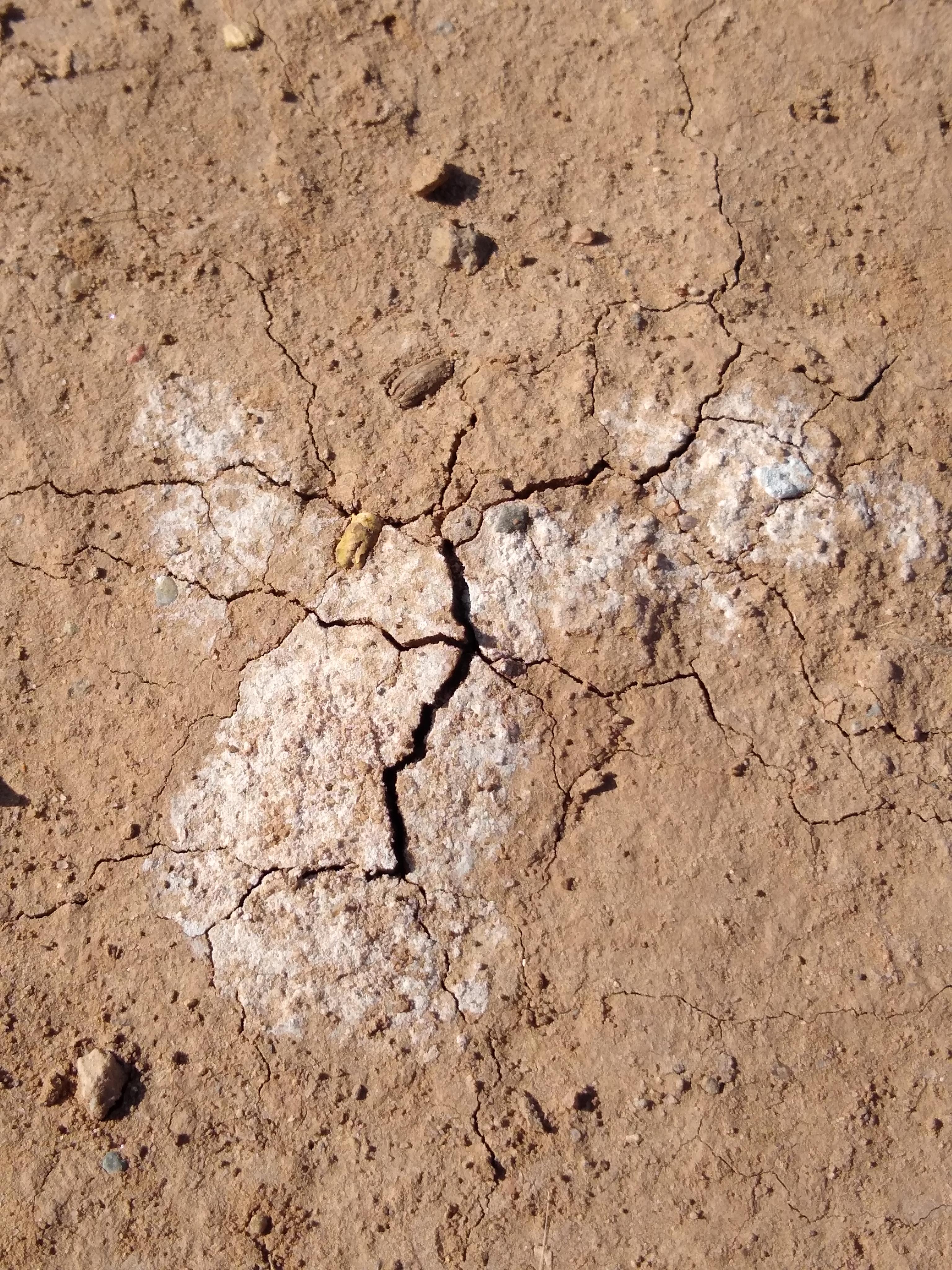
Soil compaction is a problem faced by modernfarmers, along with salination. Here is a picture of salt rising to the surface and interacting with ice crystals to fracture the ground. Typically called frost heave, this clay is brought in by engineers by the truckload because it is impermeable to water and forms the levees and canals we all walk along every day when walking our dogs. Unfortunately, dog urine, bird poop, and water evaporation all contain salts that makes the surface of dry clay brittle.
Waste water treatment is a thorny subject that does not get easier to understand by changing the words we use to describe bacterial pre-digested human poop pumped into our river. The water is "clean" as it is released into the newly created wetlands, but the water is very different that what is currently there naturally. It is warm, clear, acidic, and full of exotic material; from pharmaceuticals and aquarium plants, to salts from all the personal care products we use. A uniquely hybrid ecosystem is slowly developing in the area. So far, the ducks are loving the thick cover provided by the willow and sunflower stands.
At the outflow area of the effluent pipe, there are two types of soil found. Where there is no compaction from human feet or vehicles, the ground is soft and spongy, with ridged and hollows formed by ice. This ground is full of fungi and microbes that hold and also release water vapor. This transpiration humidifies the air just above the ground, creating a beneficial ecosystem for fragile seedlings.

Where the soil is exposed to human activity, it is a dry crust the consistency of concrete where no plants can grow. On the slopes, the soil is deeply carved by gullies, salt patches can be seen where the water is trying to reach the surface, but is evaporating into the dry air instead. Soil is something we all take for granted, even farmers and conservancies who should know better. We have a choice to manage our wetlands, but who is asking what type of soil is it that we want to nurture?

"We abuse land because we regard it as a commodity belonging to us. When we see land as a community to which we belong, we may begin to use it with love and respect."

- Aldo Leopold