Translate

Wednesday, January 14, 2026

Icy

Corrales is constantly going through changes as the seasons cycle from long to short days and back again. Not all the things we see are obvious. The quiescent phase before the activity of summer is important, a sort of staging area for the main event.
 Birds have long ago converted their feathers into far more than just devices for flying and keeping warm. This heron is not yet molted into the finery it will have later during the breeding season. Water birds at this elevation have to deal with a lot of wear and tear on those vital feathers from aridity, high pH, and UV exposure. This is part of the reason why many migrating species don't stay here long. This heron will change it's appearance around August and be ready for courtship after that. But it will never lose more than 1 or 2 wing feathers at a time so stays airworthy if a little bedraggled.
Turkeys are sort of different. Their feathers are much more durable. The melanin that makes them black is actually a strengthening pigment. Those beautiful iridescent body feathers are being replaced now to look their best for breeding season which is almost year round. They are quite explosive fliers but have no endurance, helpful for a bird that roosts in trees each night but doesn't migrate. That white meat found on the thanksgiving table is usually the big muscles used to power their short but strong wings.
January is when the great horned owls are beginning to figure out their nesting arrangements. You may notice them hooting in the evenings as groups define their boundaries prior to egg laying.
Woodpeckers are a genus of bird that has learnt new ways to find food. Red shafted flickers are insectivores that look for food mostly on the ground, so they disappear when the ground is frozen. They eat ants, easy to find but not as nutritious. 
True woodpeckers are able to stay in Corrales year round as their food doesn't freeze or hide underground. Actually it becomes easier to find as the dead wet wood flakes off. Foraging activity goes still go way down and they become far less noticeable until breeding season comes around again.
Beavers are plentiful around the Rio Grande and they leave a lot of evidence such as this tree stump. They feed exclusively on the thin, living layer of sugar just under the tough bark and constantly grind down their teeth by felling young cottonwoods. Usually to feed on the smaller upper branches. Beavers do still build dams, but this far south can also be found in tunnels dug into the side of rivers.
This snail is Physella acuta, found at the Harvey Jones outflow, which is basically the effluent from Rio Rancho wastewater. The heavy nitrate load and low sediment feeds duckweed and looks very different than the usual muddy, alkaline river water, creating the ideal environment for freshwater snails which would otherwise be found in areas much more upstream at higher elevation like Taos.
Treated wastewater is usually frost free and stays warm most of the winter. This allows many creatures such as frogs and leeches to thrive. However the oxygen concentrations are low due to the abundant bacteria so there are relatively few fish, thankfully, as many people still flush store bought fish down the toilet.
Asiatic clams are quite abundant in the river and are increasing their range and density since they were first discovered in the 1980's. Native clams long ago became scarce during to changing river conditions. How this will affect future ecosystems is very much unknown.
This is a predatory nymph from a darner. They can spend several years existing aquatically before developing into a flying, reproductive form. They are often found hiding under rocks to avoid being eating by roosting birds such as ducks, geese, gulls or cranes.
The common name for this insect is "bloodworm" but is is actually an insect, with a segmented body and small prolegs. Eventually they become a midge, flying in large clouds about the water in the winter.
Not all fungus are the same and this is a bit of an unusual one. It has an inverted mushroom cap that holds a spore body in a small cup. This is designed for a raindrop to land on it and propel the "egg" several feet away, allowing fungi to develop on new substrate.
Plants don't have feathers like a bird, but they have developed trichomes which serve a very closely related purpose. A dense wooly coat of whiskers help this young plant moderate the humidity and temperature around the new cells. Ice damages cell walls and is one reason why young shoots are sweet, the sugar reduces the temperature at which damaging ice needle crystals form.
Ice forms a multitude of shapes from plates to needles, but the basic design is a hexagon. In a cold. moist atmosphere water solidified fleetingly on the surface of the hexagon to form these almost perfect six pointed stars.
Brassica plants like this London rocket reproduce quickly from small seeds. The cold inactivates the flowering inhibitor enzymes and the almost explode from the ground is bright green splashes to seed and flower before anything else. If they then die due to unfavorable conditions later, then their progeny will remain dormant in the ground until the next hard freeze releases their restraints again. Thee flowers can self fertilize if insects do not appear.
The cold snap affects other animals differently. This small songbird is a seed eater and is waiting for the weather to warm up to flying temperature while fluffed up feathers keep it cozy
Ice releases latent heat as it cools. Counterintuitively, as long as water is continuously freezing, the temperature of the leaves stays at freezing but doesn't drop further. This protects the leaves if they contains a bit of sugar in solution. This is how shoots can survive a snap frost, but will wilt if the thermometer drops too far, or too often.
Many insects, like this Arizona Black hole spider will move into the house to keep active in a cold spell. Encounters with humans are always worse for them than you. Many species, from mosquitos to wasps and hummingbirds are actively evolving to adapt to human conditions and will continue to do so into the foreseeable future.
How the world changes by season is very predictable, but the future has many effects caused by humans that are less murky such as climate change. Hopefully we can all learn to adjust for the inevitable that comes with these changes.

Wednesday, December 17, 2025

Invaders

 Corrales continues to be a riparian habitat and the water table has recently begun to rise; either as a result of recent water releases to meet our water debt to Texas, or as a result of rains last month. It is  not easy to tell. The change in water level of even a few inches has a dramatic effect on the plants and animals Corrales will see.

Drains in Corrales perform two purposes, either to drain water away or to transport it in. Both goals are somewhat redundant in these modern times, but these legacy drainage systems have not yet gone away. A fact that the local wildlife is very grateful for.
The Rio Grande is much tamer than it used to be for past generations. Channelization and dams have reduced the extreme water surges, allowing the city of Albuquerque to grow right up to its well defined banks. Still, the river can still spread over a wide area at times, reshaping the banks and changing the plants and animals that live there. Low land river features such as rills, oxbows and sediment create a wide variety of habitat.
As soon as there is surface water, the mallard ducks return to the ditches of Corrales, enjoying the shallow still waters for feeding and pair bonding. At first they are very shy, but this will change as the season continues. The newly inundated features are very attractive to these omnivores.
Mallards are generalist feeders that can also transport different species of animals either inside or outside their bodies. This small snail is known to survive the passage through the digestive tracts of water fowl and have been slowly  spreading out of California where they were first introduced from New Zealand. New Zealand Mud snails are poorly studied but have the potential to be very disruptive to the ecosystems they are introduced into.
Many plants are adapted to changing moisture in the soil. One such plant is the goldenrod. After the Boston Tea party, settlers drank so called "liberty tea" made of goldenrod which has a slight licorice flavor. Henry Ford is said to have experimented with rubber made rom a varietal of goldenrod, but then he experimented with lots of weird things.
The Teasel thistle is dependent on waterlogged soil but not found this far south. This picture is from Taos. The son of Charles Darwin claimed the species was proto-carnivorous, but this is debated. They are well know for providing winter seeds for birds such as goldfinch.
The Osage Orange is not a native species, but was planted by settlers as a natural fence. The wood is rot resistant and the fruit very distinctive. The oil can be found online, but the claims made or it are iffy.

Mushroom can be surprisingly common in the Bosque. This is Bonestem, a fungus species that seems to prefer locations that are disturbed by human activities. This describes he Bosque very well, in spite of the natural appearance of the preserve. It is considered edible, but not remarkably so.
Bracket fungus are found on dry, dead trees, they are known as conks are usually are a sign that the tree is unsound. They do well in dry conditions. The material they are made of is related to insects and trees and is quite unique.
Life fungus, the dwarf mistletoe mostly lives hidden from sight under the bark of a coniferous host. They can be a pest in commercial operations but they don't seem to have much effect on wild populations. Because they spread by explosive seeding, they do well where the trees are dense and all of similar age.
Broadleaf mistletoe are found on poplars and other deciduous trees. Popular around Christmas they use birds and a sticky residue to spread their seeds to other trees. They grow slowly but often are seen densely on older trees just because they don't die back each year like other plants. They appear to be food or quite a wide variety of animals.
Porcupines live quite active lifestyles or such a slowly moving creature. In the winter they feed on the inner live bark of trees and can be destructive if a population is confined in one place. They usually move from feeding areas in small trees to sleeping quarters in a larger tree, but sometimes decide to sleep in late.
Russian olive trees and young elms seem to be favorites in the winter time, but they also seem to like fallen apples and mistletoe. Their droppings and marks on the bark are distinctive and while they have few enemies, they are hunted by mountain lion and horned owls.
Dead wood is a prized resource for many in the bosque. Beetles and other insects feed and shelter in the soft wood. Birds and other animals hunt for these morsels during the year and the soft wood eventually builds up nutrients for future generations.
Future generations look different for different species. Cottontail rabbits breed rapidly and seem immune to hunting pressures, disease, or starvation. Mice also do well in this human altered environment. Careful stewardship is important and not really available to the village. So far we have been lucky. Caution is needed, because the only way we will appreciate the wilderness without a guide, is once it has gone.


Tuesday, November 25, 2025

Colors

 Skotogala

Colors in Corrales are amazing, and we often see the best ones in the late fall. The orange of ripe pumpkins is usually reflected in the last of the autumn leaves. But vibrant hues are seen in many places if we know where to look.

               New Mexico does not usually get to see the aurora borealis, but his month we were privileged to get quite an amazing view for one night during an intense solar storm. Magnetic particles in the upper atmosphere interacted with nitrogen in the lower atmosphere, releasing neon hues. On November 11-12 three solar storms converged and gave New Mexico quite a firework display for a brief period overnight. We also saw other visitors.

               The sandhill cranes visit New Mexico every year quite predictably. They must be quite used to the auroras at the latitudes they spend their summer nights, flying as far north as Russia and northern Canada. They draw attention to each other with their bright red heads during the day, as well as their loud calls and balletic dancing.

               Someone who does pay them attention is the coyote. While these do well by being mostly omnivores, they are not above snagging an unwary crane is the chance presents itself. Either feathered or furred, both animals like to frequent apple orchards and corn fields. Coyotes are very good at blending into their environment, and few people notice they are there if they don’t want to be seen. While reviled they are quite important to the whole ecosystem.

               Leaf litter is usually viewed negatively as well, which is weird in light of their value to the future. It is an important resource for seedlings during the mild winters when plants are still able to grow despite the short days and cold nights. Seedlings such as hackberry trees benefit from the minerals and moisture found in the deep leaf litter. Dead leaves also insulate from the freezing air that could damage a fragile plant.

               Many insects also benefit from leaf litter. The moisture and warmth protect larva of many insects who might otherwise not survive the winter. The larvae of a hoverfly might spend a mild winter feeding on aphids, while the adult emerges in the spring to be an important pollinator. Despite the fly’s bee-like appearance, this fly is completely harmless to humans.

               The colors of the fall and winter are quite impressive, but they do not exist in a vacuum and may even one day vanish. Sandhill cranes were once rare, as their cousin the whooping crane is now. Coyotes thrive because their predators, mountain lion and wolves were extirpirated. We don’t even know how many insects are vanishing as their protective leaf litter is cleaned away. Even the heavens are vanishing. The aurora needs dark skies to be seen, and when was the last time most people saw the actual milky way through the lights of cities?


Wednesday, October 22, 2025

Rain

 “The gentle rain, that falls unseen, Softens the earth where man has been.”

Byron

Corrales is a place with many strange colors, shapes and things to see. Most of these need a closer look to appreciate what they actually are. The wilderness off Corrales is actually a lot more artificial and managed than most people realize, but there is still a wild beauty all around us.

This beetle is one of the ladybug species. Usually these eat small aphid insects. It's full name is Harmonia axyridis. It has been introduced to the US from Asia to control scale and aphids. These beetles often hibernate in winter, but as their lie span is about a year, they usually hatch a new generation each spring.
This is likely a variegated meadow hawk dragonfly. These are more often found in tall vegetation and don't see to be dependent on open water areas like other larger species. You can see the wings are a bit dog eared and worn out with use. This adult will die as winter comes on, the next generation is probably already. Underwater nymphs that overwinter in pools of water with vegetation stems to rest on.
vegetation in Corrales gets quite dull in the autumn. Plants don't produce reproductive structures like flowers when there are fewer pollinators around. This is Oenothera flava, a short lived, short stemmed plant adapted to the cold and wet of Canada. This plant blooms at night and is used to indicate the health of moth pollinators.

The interior drain is a contentious issue in Corrales, but everyone can see the vegetation loves the increased humidity and lower summer temperatures in that trench. The increased mowing needed does expose the abundant mice that were once hidden to those predators; such as this great horned owl. This picture as taken in near darkness, but by the wonders of AI the image appears to be almost daylight.
Woodpeckers, flickers and sap suckers are related birds. This is a red shafted flicker, they appear to over winter in Corrales. They feed on beetles and ants, often being found on the ground more than other birds. Their triple call sounds a lot like a Cooper's hawk territorial call, but ornithologists are not sure if this is an example of deliberate mimicry or not.
While New Mexico snails are pretty rare, we do have some weird specialist desert snails. This, however is not one of those. It is actually a predatory snail, feeding on other snails and their eggs. It was imported into California for this purpose, but tends to cause declines in native species as well as pests. It is called the "beheading snail" because it purposely snaps off the pointed tip of the shell to help burrow into the soil during dry periods.
This is likely Richia parentalis. These moths are hard to tell apart easily. Moths like this require leaf litter to protect them from freezing and desiccation while they overwinter in the larval stage. The adults are quite short lived but awesome to look at up close.
The weather is now perfect for seedlings, the morning dew helps keep humidity high and the temperatures are not too hot. There is also still plenty of light for growth, giving perfect growing conditions for those that can take advantage of it. The weeds are adapted to germinating quickly because of the human habit of destroying everything back to the bare earth. Most of these seedlings are Kochia, which ironically used to be a farmed crop, but is now a weed because it grows so well.
Coyotes have adapted very well to humans, especially as we removed their biggest predators, wolves and mountain lion. They live unmolested in the open spaces across the river, but are tempted into Corrales by mice, and apple orchards.
Orchards in Corrales are in decline, but the trees that are present are incredibly productive, often to the point of being a nuisance. From experience I can say each tree requires at least a 1/2 hour to pick. The variety of trees is huge. Although we see nothing like the diversity and abundance the trees once enjoyed throughout the US in their heyday. This was actually 1994, with 11.8 billion pounds of apples harvested in the US.
Mushrooms in the wild should never be eaten, it's just too easy to mistake them and the results range from upsetting to terminal. "All mushrooms can be eaten once, some can be eaten more than once"as the mushroom huntters like to quip. The gills release the spores that mushrooms use to reproduce instead of seeds. The actual methods of reproduction are mind boggling and vey complicated.

This mushroom looks more familiar, with the typical veil, marking it as an Agarcius species. Could be edible but I would never risk it. Look closely and you might see the small insects already moving in. Those are likely springtails and they have a whole ecology sprouting on this shiny white cap.

Corrales has enjoying a late Autumn rainy season that will be all too fleeting. But while it lasted, we can see a whole system of ecology around the extra moisture, from mushrooms and seedlings sprouting, to apples falling and those coyote visits. All these things should all be appreciated because they quickly will pass. They are all so fleeting and valuable.


Wednesday, June 4, 2025

Float


Drink deep, or taste not the Pierian spring :
There shallow draughts intoxicate the brain,
And drinking largely sobers us again. Alexander Pope

The weather is being ideal for plant growth, cottonwood dispersal, and toad courtship. Temperatures are good, with some moisture and slight winds. This means the ecosystem is thriving now, with plants growing, attracting insects, which in turn bring birds into the Corrales trees.

This insect is the larval form of Orchestes steppenis. common name Elm Flea Weevil. When elms in the US began to become affected in 2003, the culprit was actually undiscovered in it's native Europe and it took a graduate student's thesis in 2018 from Ohio State to figure this all out.
The weevil larvae starts feeding by a process called "leaf-mining. Where it eats the leaf from the inside, effectively walling itself from the outside world of dehydration and attacking insects such as praying mantids and parasitoid wasps. When it matures in the hot summer is seems to drop to the ground and go into a torpid state until the following spring.

There are many predators of the weevils that keep things in check. Spiders are a common one and not often recognized for their services to gardeners. This spider has two names, depending on the fear it inspires, either the cupboard spider, or a false widow. Both names belong to the genus Steatoda and refer to the same insect
""The best way to prove the clearness of our mind, is by showing its faults; as when a stream discovers the dirt at the bottom, it convinces us of the transparency and purity of the water."   Alexander Pope

irrigation is a very old form of land management and is still used in Corrales. It not only irrigates fields for crops, but can also be used to prevent weeds from forming. The muddy water from the surface water chokes out kochia and other weeds that grow, letting the farmer chose when and how the plants should grow. The depth of water, clarity, composition, and temperature all help decide which seeds grow and which will wilt. Here you can see the short grasses geting flooded while the floating water plants such as Didymosphenia geminata continue to grow in the sunlight.
Other plants grow preferentially in the shallows. The succession of plant growth from pond to meadow are quite well known and often start with tall grasses, such as rushes. As detritus collected between the plant stems the ground rises until it is dry most of the time. Here you can see a surface sheen that looks pearly, this is a mixture of dust and pollen that slowly over time forms a fossil record of the plant activities of past seasons.
Pollen is released by insects but also on the wind. These are the catkins of the coyote willow. They don't look much like typical flowers but are able to send out large clouds of pollen when the time is right.
Ants and wasps are part-time pollinators but come in a dazzling variety of species. This ant is actually a small wasp. There are probably about 40,00 unrecognized wasp species but this one is probably a braconid genus..
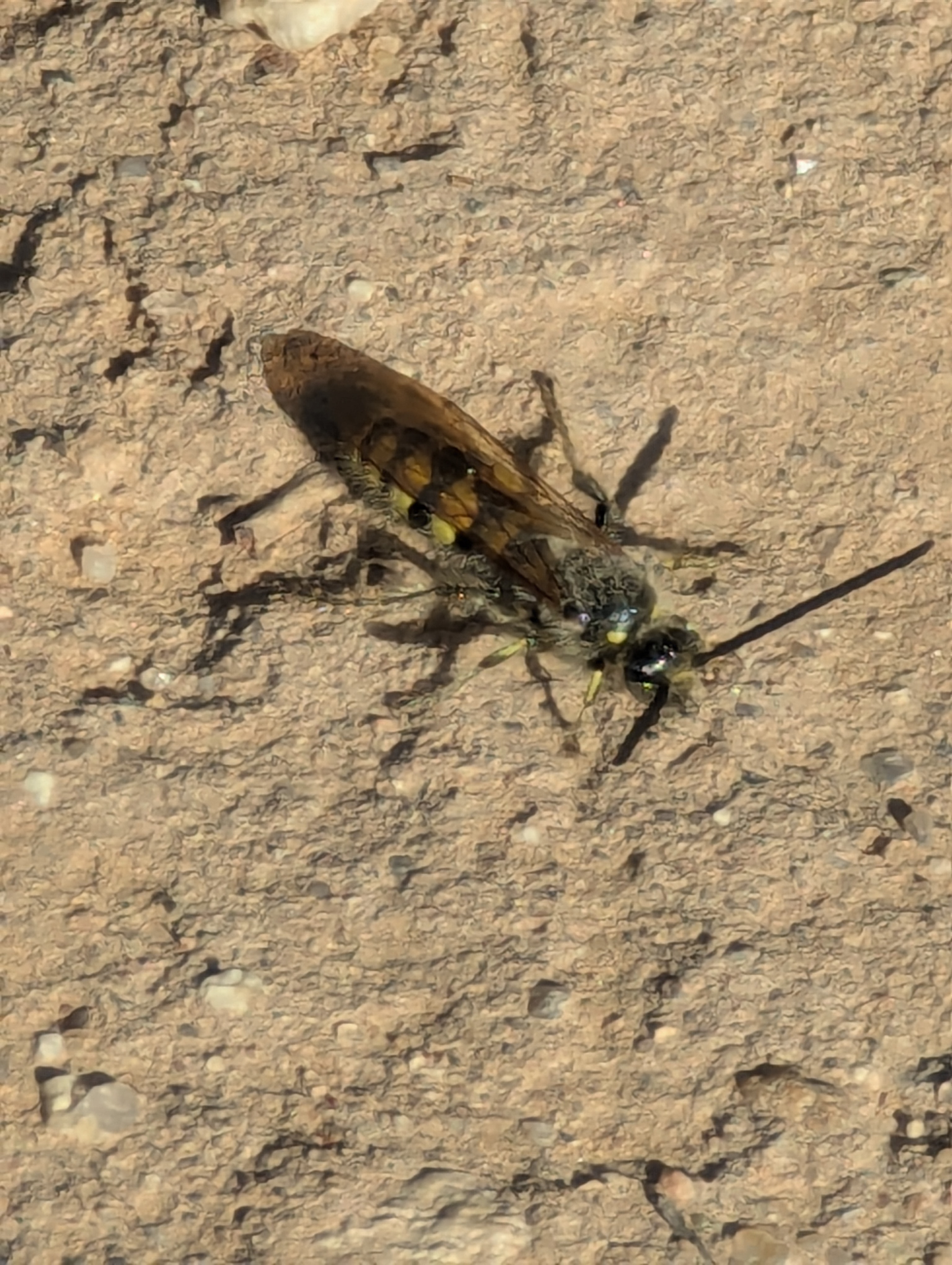
Most people fear wasps but often forget the insect eating abilities of those such as this scolid wasp that hunts for underground beetle grubs to use as living larders of the eggs.
"All nature is but art unknown to thee; / All chance, direction, which thou canst not see." Alexander Pope
Woodhouse toads need flooded fields, with semi-permanent water and night time temperatures above 60 degrees. In a few weeks their little progeny should be jumping all over the ditch banks as if by magic.
"Truth needs not flowers of speech." Alexander Pope
The range of plants is quite staggering. Its not surprising really as they have been evolving for about 140 million years. This flower is called a paintbrush and produces heavy amounts of nectar to attract hummingbirds. They are a hardy plant used often in xeric landscapes, however they are hemi-parasitic, dependent on host plants and react poorly to transplanting. Oddly, it is used to produce a black dye for deerskins
This delicate flower is called an evening primrose, but it is not related to those species. They are drought hardy and have many medicinal uses ascribed to them. It only has four, heart shaped petals which are semi-transparent.

The salsify flower is a rugged species of aster, much like a dandelion but much larger. Its full name is Tragopogon dubis and is another introduced European plant. Apparently the cooked roots taste like oysters. There is a paradox in that we have an almost infinite variety of choices of what we eat and consume but the easiest, is the one that takes the least thought and effort, always the choice that others are selling to us.
Many people are fascinated by birds. They seem to express something that human seek within themselves. They are exquisitely adapted and also endlessly adaptable. Often they seem so smart in how they look for food, how they migrate and how they present themselves to the world. This wren shows the classic thin beak of a insect catching species.
After the rains many birds examine the lay of the land. This finch has a large beak well designed for many feeding tasks. The brief monsoons have unleashed a large number inf insects that birds spend most of the day looking for and catching. Later in the year this same bird will switch to a diet of fruits and seeds as it can find them.
The red wing blackbird relies on water and swollen acequias to provide nest cover for the female. The male uses a loud voice and a pair of flashy epaulettes to draw attention away from her and towards himself.
    For a land dominated by dry grassland, fresh rainfall moisture can certainly change how the bosque operates. The plants insects and animals all go into a sort of overdrive as the hot dry road of time continues. Often I wonder why humans don't appreciate the stability of the world around us. We focus on the negatives in our own lives but the vast majority of the world seems to amazingly be able to spin around without any kind of intervention on our behalf at all.