Translate

Sunday, May 26, 2024

Awake


"Nature is a labyrinth where one can easily get lost. But nature is also a bridge that can lead us to a higher level of consciousness." - Eckhart Tolle (German spiritual teacher) 

Studying nature is ideal as a way to focus on complex themes in human ideas and emotions. Bucolic poetry from the second century often studies allegorical ideas of love and passions. In prehistory times, of course, nature was the only teacher and did not need to be so formalized or written down; the evidence was simply accepted.

Oddly, perhaps, science is very poor at understanding the natural world. In our modern world we often use nature study to learn activities such as oratory via published papers or divination via genetic sequence erudition and analysis. Actual contemplation of mysteries via literature seems to have been discouraged in modern scholars who have no time or mentorship for such frivolities.

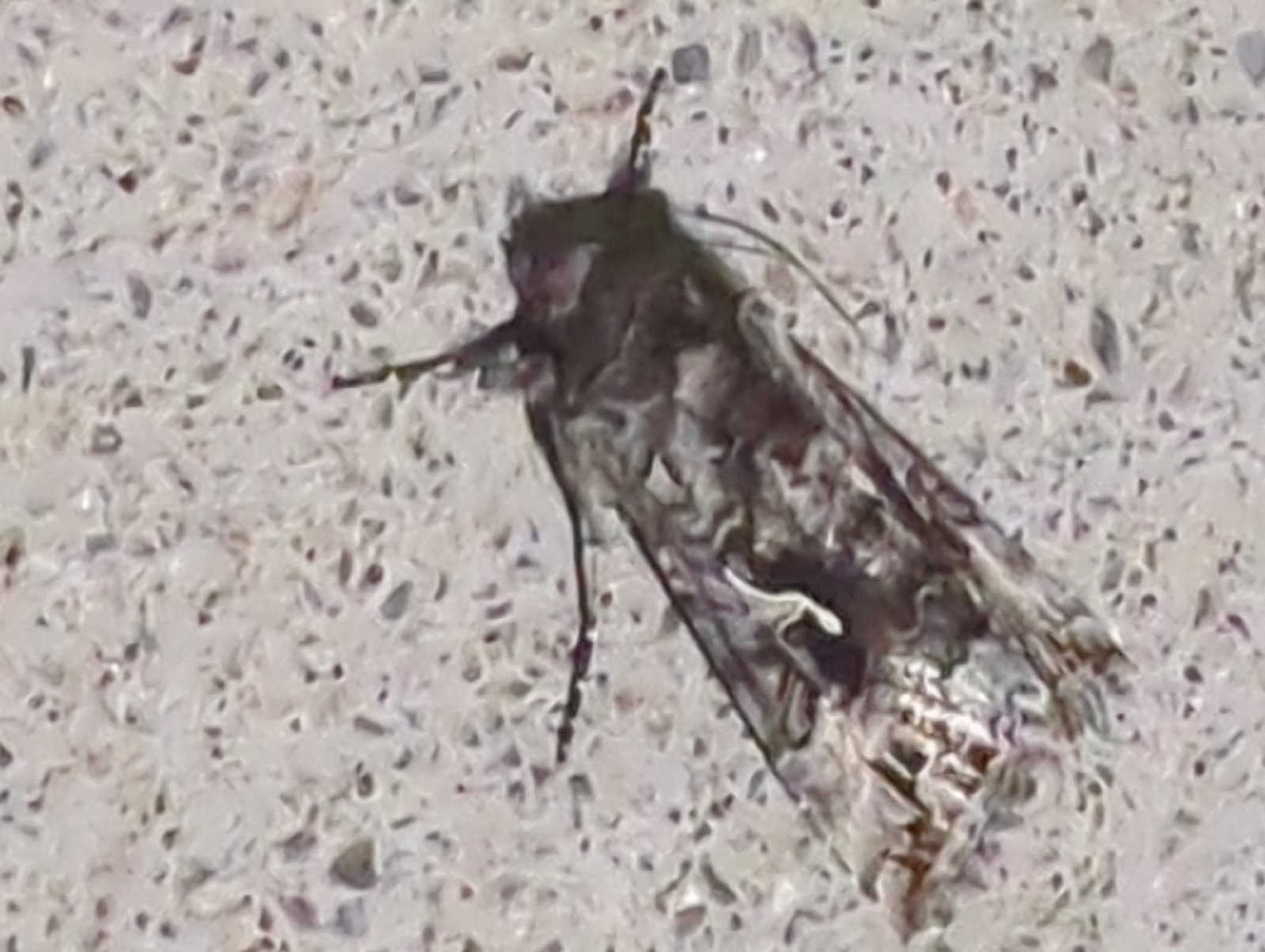
Contemplating this cutworm moth in its cocoon of webs and leaves is an interesting exercise, none the less. The insect phenomena is very brief and has now already vanished. This probably explains why there is very little official literature on what is happening here, online.

 It can be a very illuminating experience studying the research of bugs itself. The vast majority of literature is based around extermination and classification of insects into worth saving versus worth destroying These are the larva of the cottonwood leaf beetle. A species that appears to be increasing in numbers for the last several years, but no actual study of their dynamics appears to be taking place in academic circles.
 Ignoring the economic, social and extraneous baggage our primate brains bring to the table, this insect is fascinating simply per se. Its structure and place in the ecosystem is deep and varied. The fact that humans classify natural things into venerate, desecrate, or obliviate seems to be an intention bias likely found in our society as a whole. They are just not on our radar.
 Population dynamics of beetles is just "one of those things" and has not received serious study. While wild fluctuation in numbers is normal, the reasons seem elusive. However, bursts in growth in other model organisms help control predation, or parasites and are keys to adaptability in any prey species.
 While looking similar, this is a ladybug larvae. It is strictly a predator of other insects and is quite generalist. However, it does not breed as prolifically and is often captured and released in vast numbers for the home garden market. These poorly adapted insects often simply leave the release site and disappear. Worse, wild caught ladybugs overwinter on mountain tops in vast colonies and are cheaply caught and sold, Released into suburban rose gardens their mortality is very high...and not studied.
  The idea of a domesticated insect is kind of nebulous, but will likely be better defined in the future. These strange animals came to America accidentally from Europe in shipments of plants and have since spread across the continent. This common woodlouse is not an insect, but a crustacean with abundant relations found in the deep ocean that grow up to 16 inches long. At the other end of the spectrum, the Socorro isopod was made extinct in the wild in 1988 and only a captive breeding program allowed the only outdoor freshwater isopod species in the world to return to the wild in the 1990's.
 The turkestan cockroach is not an indoor pest and has only existed in the US since 1978. They are most common in the Southwestern US and are used in the the pet trade as food for various reptiles. This insect is known as "peridomestic" whatever that idea means.

Mosquitos do not feed on human blood per se, they actually need the proteins to build egg cases and prefer to feed on sugary fluids in plant life. The process is dazzlingly complex and understood only because of the the economic importance mosquitos play in human lives around the world. If you have an interest in fat bodies, vitellogenesis, or transaminolation there are reams of articles to peruse. The fact that there might be such a wealth of undiscovered knowledge about boring insects such as ladybugs, cottonwood leaf beetles, or isopods is quite a thought.

Bluebells are a crazy plant that relies on long tongued bumblebees to pollinate the flowers and ants to disperse the seeds. The petal color changes depending on the acidity of the soil. Much about this plant is cryptic. Even the flower shape is officially trumpet shaped rather than bell. The genus has an area of high diversity in the Rocky mountains, including parts of Jemez mountains, but molecular phylogenetics are needed to separate most of them.
Desert columbines are a weird looking plant that have evolved to be pollinated by specific pollinators. The flower pictured here is being held upside down, the stamens are normally pendant (hanging) with petals pointed upwards in spurs that hide the nectar sources long enough to be found by pollinators such as hummingbirds that are particularly attracted to the color red.
Here is a fascinating and rare insect, which almost no one is interested in precisely because of this rarity. Meet Cyrtopogon jemezi a robber fly that grabs insects on the wing and eats them. The coloring makes this insect look suspiciously like a bumblebee. Those distinctive fuzzy yellow legs are quite dazzling.
The American bumblebee is well known for officially defying the laws of gravity, although this isn't so if you account for the differences of scale that allows air to behave more like a thick liquid than a thin gas. Bumblebees go through diapause during the cold months and emerge from hidden burrows to feed on nectar of many types of common plants.
There are many types of bees and many unusual critters out there. This one was found on a cold, wet morning and appears to have large blue striped eyes. The type still has yet to be identified by me, but I am working on it. Its not usual, apparently about 10% of bees in the world are unknown to science. There is just too much we do not know. How does society handle the unknowable? Usually by minimizing it
The carrot beetle is only known because farmers found them on carrots, even though they exist on many other seedlings as well. They are not an economically important pest (because carrots are not an economically important crop) and their numbers can be controlled more through good practices rather than chemicals. Adult toads are often found in the summer under porch lights feeding on these beetles that are attracted to the lights. One of the first cases of crop damage recorded was in 1909 in Portales, NM when they were recorded on the roots of a celery patch.
Enallagma cyathigerum (common blue damselfly). The blue male has clasped the female behind the neck while her copulatory organs are pulled forward to form a mating wheel uncannily in the shape of a heart. The females come in two colors, or morphs. The pale ones like this are more identifiably female and have more reproductive success when males are scarce, but are less successful at hunting due to constant reproductive pressure from males. The other morph of females are similar color to the males and receive less attention when near water.
Moths come in many flavors, with very different patterns of behaviors and locations. This family of moths called Noctuidae is pretty mysterious and the definition of the type keeps changing. Inside the middle segment of the moth body is the hearing organ called the tympanal organ. Inside that is a vibrating sheet connected to the surrounding walls via a conjunctiva. Between the membrane and the conjunctiva is a structure called the epaulette whose shape is used to separate different moth species. What this structure is for is debated but it is likely used to prevent mites from damaging the moth's hearing, which it needs to evade bat predators.
Wolf spiders are very adaptable and are often found near to water sources in large numbers where they ambush small insects. Webs are not helpful in wet environments so they are better at agility and visual hunting. Their ability to run short distances over water is usually an escape strategy to avoid pursuing lizards.
Event though this insects are often called moths they are actually a fly species that eats bacteria when in the larval stage. The adults use specialized hair like structures to avoid getting wetted, meaning thermal or chemical treatments will not affect them. They appear to have only become noticed in houses since the early 1900's.
Recent flurries of rain have allowed snail migrations. The common garden snail shown here is actually used as a skin cream ingredient. While these snails are not considered a menu item in the southwest, they are being studied for alcoholic gastritis and anti Alzheimer's preparations. There are native species of nails as well, 50 miles north is the little known Ashmunella ashmun, found in Jemez Springs it is listed as critically imperiled.

As populations of things grow and develop into adults the learning to reach higher states of consciousness in the observing humans continues. Tadpoles are good for observations as they have such a drastic change in lifestyle as they grow, A vegan,tailed, gelatinous ball with gills morphs overnight into a tailless insectivore with legs and a grimace.
A frog is possibly the weirdest mixture of features in an animal. They are poor at most things in life. They can hop for only little bit, they can drown, they swim but not enough to avoid predatory fish and do badly in fast moving water. Actually many of the 6,000 species of frogs prefer to live in trees or on cliffs. Some can parachute. In the desert many frogs only are active a few weeks in the year. Yet this leopard frog is absolutely ideally designed for marsh life. Beautiful animal to boot.
 Woodhouse toads are another crazy species. They don't like swimming and are mostly found inside mammal burrows. There is no animal, humans included that have a better stink eye/ grimace.

Corrales is actually involved in the story of American bullfrogs spreading from the southeastern United States. This animal was farmed during the great depression, but the experiment failed due to the constant flooding that used to exist in Corrales. The prior link in this paragraph is well worth a read.
While most people think coyotes are after their pets and small children, most New Mexico observers notice that they are hunting the mice and other rodents exposed as the summer season of cutting weeds begins. As someone who regularly drives late at night it is obvious that large subdivisions built out in the desert attract large numbers of diverse rodents.
globe mallows are a beautiful prominent flower found in the hot sun. Often they can be found with a small native bee nestled within the flower. The vast majority of bees are solitary, the honey bee is not a typical species and these flowers are usually a host to Diadasia diminuta, a specific bee that not only pollinates, but uses the flower as a temporary shelter for cat naps.

The marine blue butterfly mostly focuses on leguminous plants for laying eggs, but his one is sheltering for a minute in the strong winds that are currently present through most of New Mexico. Small butterflies are able to exploit ecological niches that the large swallowtails or monarchs cannot.
The chequered white butterfly is very common and found in areas of tansy mustard that blooms and grows in the early spring in Corrales. They often sun bask by reflecting light of the wings onto their darker bodies. While common, populations move around a lot and often disappear from a location for years at a time and not found in areas of dense shade under trees.
The green sunfish is very protective of space, acting just like a small yappy terrier. This behavior is odd, as the males often choose to nest in close proximity to each other. This male is showing the red eyes showing it is in breeding condition. Their toughness allows them to live in unstable environments like ditches where the water levels fluctuate rapidly.
Common snapping turtles are very secretive and shy, always avoiding confrontation in the water but acting wildly when caught out on land. But then, humans swimming in water when something brushes against them act the same way compared to something brushing against them on land.
 The mid rio grande population is a bit of an anomalous outlier, but they have been in this river since at least the seventeenth century. They are known to continually grow throughout their life, but their maximum lifespan is unknown. Humans seem to get hazy on science for animals that live longer than ourselves. Turtles can survive without lung breathing if they don't need to move. They can also breath anaerobically in certain conditions. They are also not picky about feeding, scavenging, hunting or eating vegetation depending on what is available, but they are not active hunters.

 Most young birds are fledging now. These great horned owls attracted quite a bit of attention before they finally left the nest and vanished. Their attentive parents are around, but if you see owls now its likely the young ones who still have a lot to learn about being camouflaged. They young birds experiment with many prey animals before settling on small mammals. While they practice hunting large insects, they basically never carry off people's small pets.

While great horned owls produce one brood every 2 years, the passerines can produce several broods if the food is available and the food this year seems very abundant. phoebes are synanthropic and rely on human structures to protect young birds from wind and rain.
Sparrows are also very adaptable birds, able to use bird feeders or foraging depending on the situation. But with 29 sparrow species in New Mexico, there is a lot of variability.
 
 The migratory birds also are highly variable. This year we have a large number of tanagers. This is a western tanager and they are very noticeable when active. Oddly they blend in very well when being unobtrusive.

Snowy egrets have joined the herons by the river edge. We have several egret species present, but this is the only one with the fine cravat of downy feathers on the chest.

Nature is confusing but the understanding can be valuable for insight into our own thoughts. This small western screech owl was hit by a car and killed while it hunted mice on the side of the road along East Ella. This is one reason for the low speed limits on many side streets in Corrales. Connecting car speeds and owl mortality is usually a bit of a stretch for primates, but the links are there. 

Right now the mouse population is more highly visible, not only because of the season, but the mowing also displaces the rodents by disrupting their nests and having young immature mice scampering out during the daylight. This leads to an increase in poisonings... of the young owls who consume this easy prey. When we realize that everything is connected by webs of fate to everything else we can also appreciate how we ourselves are woven into this tapestry, affecting everything around us. Thinking more about our actions is likely a good thing if we are able to handle it. Those big brains we are so proud of can do so much more than cause death to small birds because we are in a hurry to get home after dark.
 

Monday, May 6, 2024

radiate


'I rose to go, and felt the chill,
And shivered as I went;
Yet shivering wondered, and I wonder still,
What more that willow meant.'
Christina Rosetti, "In the Willow Shade"
Plants have all sorts of associations with poetic concepts and the willow is one of those with MANY connections to myths and legends. But the concept of love, death and beauty is always connected with  plants such as weeping willows. At least, since the English literature of the 15th and 16th century. The weeping willow is actually a cultivar hybrid species, carefully curated since they were first introduced from China and immortalized on the British porcelain pattern.
North America is home to about 100 species of willows, and these plants are a mainstay of the Corrales Bosque. While cultural references to willows are vague, biologically, willows are very unique plants. They have insect pollinated catkins. They are found where there is abundant water for their roots, and their sap is very watery. While the plants do produce an aspirin derivative, this chemical is actually a plant hormone and found in many foods, including beer and coffee. Is is used for many things by the plant, including plant-plant communication.

There are many plants called willows, which actually are not. All willows are water loving plants, which is in high demand in the New Mexico climate. The rain here is not only sporadic, but often it evaporates before it even reaches the ground, in a weather phenomena called virga. This can be seen in the photograph as grey curved streaks in the sky. The water stored underground is of far more importance to many plants in New Mexico, without which they could not survive.
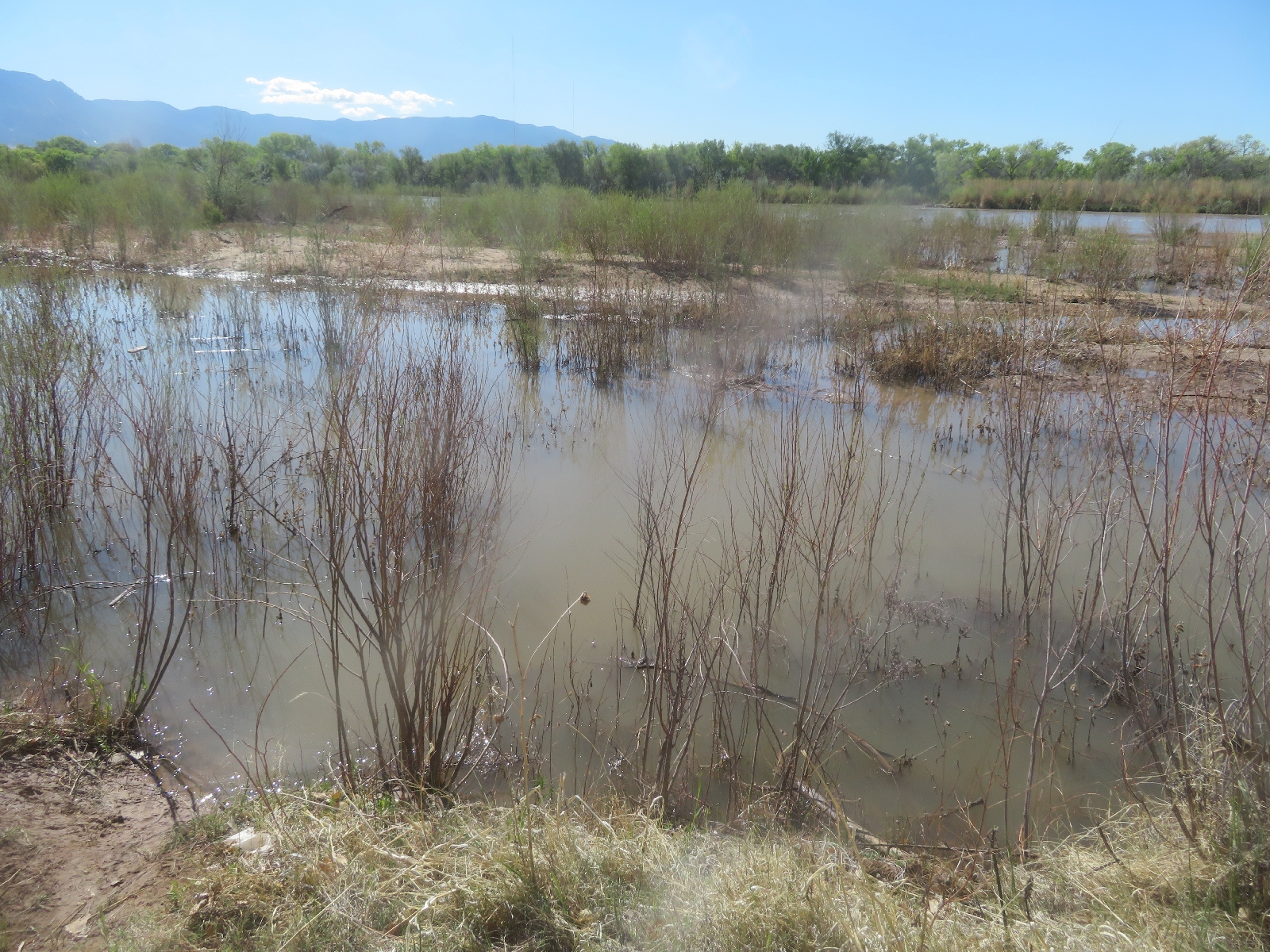
The high river levels means standing water in the coyote willows swales. A whole unique riverine ecosystem is regenerating. From seeds, insects, amphibians, visiting birds and other animals. New life is literally flooding into the forest. The dense undergrowth will retain the coolness and moisture during the hottest months and allow the cottonwood seedling to establish. Willows have some of the longest growing seasons of the plants available here. The plants with the longest growing seasons seem to have the best chances to establishing themselves. Its one of the reasons invasive plants like ravenna grass is able to dominate.
This duck egg fragment is all that is left from a nest of a domestic mallard. Wild bird nests are protected by federal law and mallards will just keep laying eggs and forming nests until they are successful. However, no one told the skunks this. The ducks use the dense underground of weeds, willows and anywhere else to hide their nests. Even though their nests seem pretty indifferent, they put a lot of work into raising their families, and this particular duck species is doing well in human controlled areas.
Pyralid, or snout moths are found in warmer climates and have long thin antennae. Some eat plants, some eat beeswax, this one is designed to look like a bird dropping. Notice the fringes on the moth wing's trailing edge. These break up their outline, muffle bat acoustic echos, and probably do many other things we just can't understand without a moth like brain. Knowing them, it likely has something to do with spreading pheromone smells around.
 mourning cloak butterflies feed on cottonwoods and willows. They are some of the first butterflies seen. Not only because they are cold adapted, but also because they are some of the biggest butterflies. Their fearsome appearance means they are left alone my many birds seeking to feed the early birds. How this butterfly is connected to traditional mourning garments seems to be a debate of some contention, although most sources just take it for granted. It seems to be a bit of a joke, because the trim and blue spots on this butterfly suggest a "light mourning" rather than the somber black.brown of "heavy mourning" of Victorian dress codes.
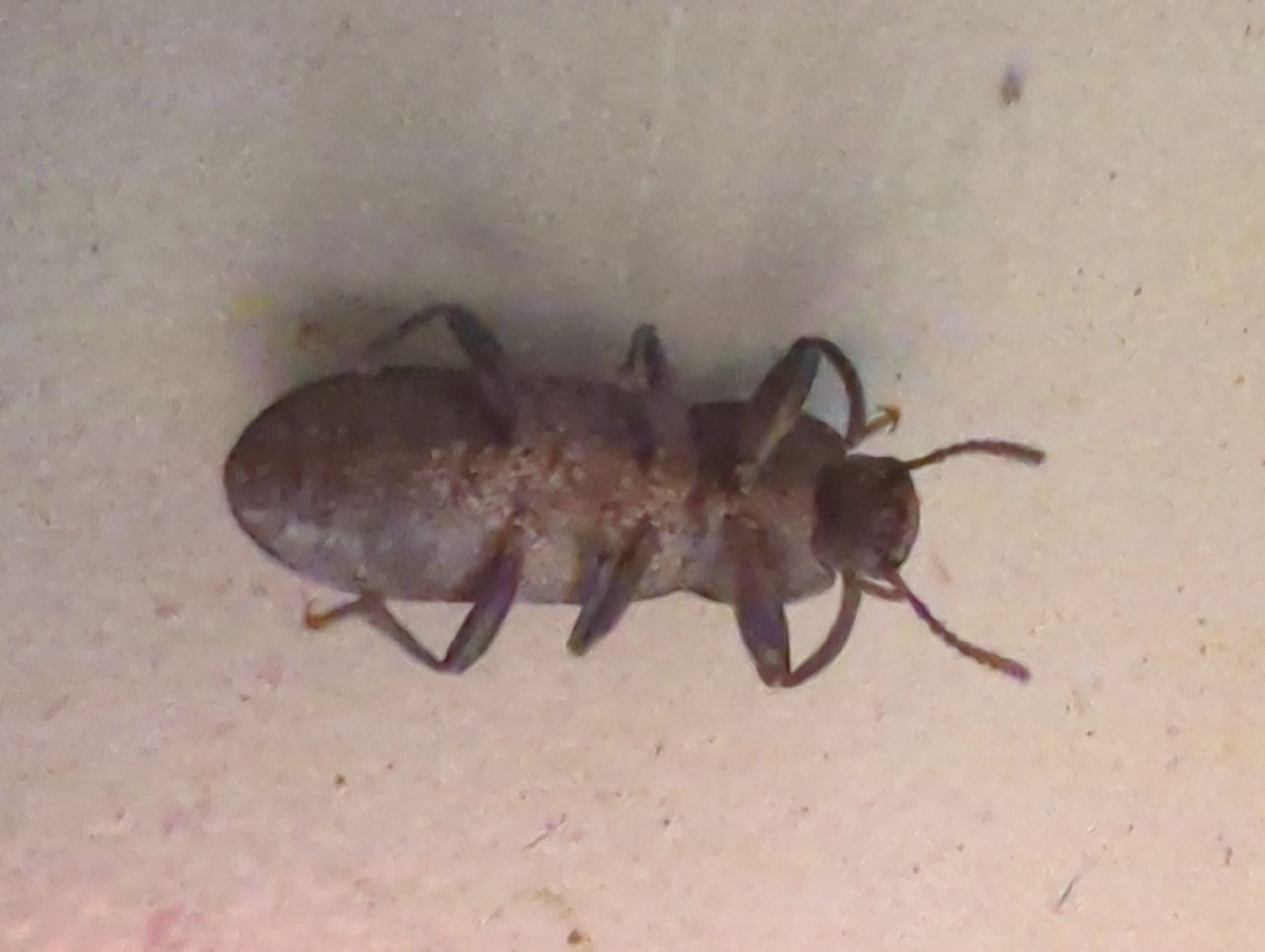
beetles can be hard to identify because there is just so darn many of them about. Like most insects, the indoors is not a hospitable place for these insects and they can often be found dead around door seams in the spring
 Moths play a  large part in the ecology of the bosque. Their larva attack tree leaves and are in turn attacked by wasps. Some caterpillar hide inside weeds, such as wild licorice, building web like structures. Others hide inside wood directly.Wasps
Parasite wasps are impressively varied. The long tailed wasps can sting beetle grubs chewing holes inside dead trees. This is a short tailed ophion wasp and they seek moth caterpillars, usually around light fixtures as the moths mate and plant to lay eggs.
 
The hairy footed scoliid wasp is much more solidly built, as you would expect for a wasp that hunts large beetles and has to do a lot more digging to get to the grubs. The deceased female was attacked and killed apparently by sand wasps. A behaviour i see occasionally but have no idea about the details.
 Butteflies always have people's attention. This is a Pearl Crescent it has very ragged wings meaning it is at the end of its life span. Butterflies, like many animals have a wide variety of life cycle strategies. but the range varies widely.
This is a great horned owl juvenile that is probably 1 year old. It is staying in it's old territory. This a bad thing because it means the owl density here is not high enough to force it out to new locations. Great horned owls are stable and easy to study, but we still know shockingly little about their numbers.
Bindweed is a plant that is thriving under the extreme pressure of human eradication. Unfortunately, evolution only needs "fitness" to be successful and plants like bindweed are very well fitted to rebounding after human intervention, unlike the other plants they compete with. The ephemeral flowers are quite beautiful, though and some cultivars are raised by gardeners, under the euphemism of "morning glory" which is actually a totally different plant.
As spring rolls into Summer the flowers are getting ready for other actors. This silverleaf nightshade uses heavily laden anthers to attract American bumblebees during the summer. It is odd that while the nightshade is an invasive species, the pollinator, bumblebees, seem very specific to geographical locations, at least, according to Inaturalist.
Right now it is not only birds that are seeking nests. A wide range of reptiles are also looking to mate and make nests. This New Mexico gartersnake was seeking a location to lay eggs, they are often seen near water sources. Unfortunately this one was crushed by a car late at night.

The toll from cars, gardens, pets and glass windows on wildlife is crazy. Some animals and plants are adapting quickly to this, such as coyotes, willows, mallards, and wasps. Others are simply fading out. Only time will tell. Species like this yellow warbler has been slowly declining and since 1966 to now has decreased by 20%. Will we notice when they are gone, or will we plant a weeping willow to symbolize their loss?

Thursday, April 25, 2024

Spume

“There are many paths leading to the top of Mount Fuji, but there is only one summit”   
 Morihei Ueshiba
 
     In Japan, Mount Fuji is revered in several religions and the summit has been a pilgrimage site since the sixth century. Now, the cliched view is climbed by hundreds of thousands of tourists yearly and treated like a theme park instead of a church.
    Like Japan, the view in Corrales of the Snadia peak travels from the mountains down into the Rio Grande river. The variety of people who visit it is only dwarfed by the variety of organisms that call these slopes home. A theme park or a church can have an equal amount of care provided to it, but which one of those two institutions can travel into the future? And why?
 In the foothills of the East mountains, the plant life is vibrant, not because of the abundance of water, but because of the scarcity of time before the summer reduces growth. Flowers advertise their wares in vibrant colors and offer sugary snacks to an abundance of hover flies and other insects. These plants are in a hurry to get the next generation ready. Even though this cactus is not an annual, the spring blooming season is very short.
Corydalis aurea is a winter annual in the poppy family. Annuals are common around human environments and where heavy grazing occurs. Many are considered weeds because of their survivability. They have short roots and survive most of the year as seeds in the soil.
Oenothera deltoides aka Dune Evening Primrose. These blooms are supposed to open at night and are usually white to attract the varieties of moths that pollinate them.
The level of the river has risen rapidly as the snow melts rapidly from the distant peaks and drains into the valley. Many people are going to again try their luck in the churning, muddy water on various one dollar gaily colored inflation devices better suited to a calm beach. Theme parks have lifeguards for a reason, because the river is treacherous. A church might keep an unprotected areas such as this off limits, but the bosque doesn't have any walls. Education is probably the best way to protect everyone.
 As the level of the river rises, the excess water seeps into the surrounding soils, both laterally and up from below. This is noticeable on the deep trails through the bosque, because they tend to be more deeply incised into the soil by the scraping of many human, dog and horse feet.

 Shallow pools of standing water are very different than flowing turbid rivers. They allow many forms of creatures to thrive, not all of them appreciated. Mosquitos are blood suckers, but both species also will usually only suck plant sap and are also pollinators.
Shallow pools are beneficial to many other important animals that are not often seen unless by those who take the time to stop and listen. Snapping turtles are found in many muddy areas and very shy. Those smaller than your hand are completely harmless, but they can grow to amazing sizes if they are allowed to live long enough by the people they share their spaces with.
Red eared sliders are more vegetarian and a lot more active than snapping turtles. They are far less afraid of people and use the heat of the sun during bouts of sunbathing to digest meals of algae and invertebrates.
 Beavers in the Southwest are exclusively nocturnal due to hunting pressures sustained over the last 200 years. These rodents have profound effects on the health of a forest over the long term. The Russian olive trees near to a beaver dam are usually left alone. Sometimes, like in this picture, they will chose to remove one growing over the water when they need dam building material.
 
 The narrow leaf willow forms part of the under story species space, that along with the coyote willow and willow baccharis form dense swales that shade the seedlings the mature cottonwoods depend upon to flourish. The succession process is complex and important, with seedlings growing on open sand bars until the willows catch up and surround them, which gives time for the long taproot to grow which allows the tree to flourish in the next five years it needs before it can form a canopy on it's own. This plant has been designated as a "garden of merit' recipient...in England.
Dogsbane is becoming more prevalent in area of open forest floor that used to be flooded, so the south end of Corrales bosque. This is a useful fiber plant that is widely dispersed by the wind. This plant seems to be related to milkweeds and has its own specialist beetle that can sequester its poisonous compounds much like the monarch butterfly does with milkweed.
 Horsetail ferns are not actually a plant, as such. They are the sole surviving species from an era 300 million years ago where they grew over 100 feet tall. They release spores, but are not ferns. Their gametophytes can be both male or female because they are not specialized like in phanerogams. When conditions are right, structures called strobilus release spores that have hyprophilic elaters. These are very simple "legs" that react to humidity and surface tension to be motile (they can "fly" and "walk" when conditions are right. Their extensive underground roots and deep starchy tubers mean they are never removed from an area once established.
The king of the bosque is the cottonwoods, a species of poplar tree. The do not have as long a growing season as other invasive tree species. Even though they are well adapted to conditions along the river they are just not aggressive enough in their growth, and the conditions along the river has been changing over the last fifty years due to climate change. That's within a single generation for most of the oldest trees.
wind dispersal is used by many plants, however, they often use fibers instead of actual wings because the high surface area allows these balls of fluff to tumble along the surface of the forest until they are trapped by moist surfaces which increases chances for successful germination. Cottonwoods can germinate from wind blown twigs embedded in mud, from root suckers, or by dispersed seeds
 While the maple samara seems more advanced, it is actually a clumsier design, only designed to disperse and slow it's descent in moderate wind. The design also lays flat after it lands, the cellulose skin allows it to float on water. The maple seed is relatively large, with good stores of energy for the seed inside.
         
 Elms seeds are profligate and send their seeds everywhere. Trees synchronize their seed release as environmental conditions such as shortening days trigger changes in the relative amounts of plant hormones the cells of the tree is exposed to. Things are never quite that simple, of course, but the elms burst their seeds everywhere and the cottonwoods follow at a more leisurely pace afterwards. Here you can see how all the seeds have been caught in a spider's web.
There is a lot of different reasons why spiders build more webs in the spring. Part of this answer is that spiders use their webs for a darn sight more than just for catching dinner. They spin tents to protect themselves from predator wasps, they advertise their houses to wandering mates, they sense their surroundings from the vibrations of these webs, they can use thin strands to fly and disperse to new locations. These flat webs are likely from a grass spider species, these spiders are among the fastest runners in the insect world, pretty large and scary, but totally harmless to humans. This is a common problem in the insect world, where everything looks alike and a few species, out of millions, are dangerous.
In Corrales we don't have the large rhinoceros or stag beetles, but the desert stink beetles get pretty large. They grow in the leaf litter of the forest before heading into the sandy uplands to feed on plant detritus as they try to avoid the hot sun and various predators.
Beetles are one of the several very successful insect species on the planet. This is a weevil, from the long apparent snout with antennae. The official name for this long appendage is a "rostrum". The genus is some sort of Orchestes.
 Beetles cover a great many niches. While the weevils are a group of herbivores that use their rostrums to bore through the tough covering of nuts and grains, this convergent lady beetle feeds on soft bodied aphids and is incredibly common, being released by rose gardeners in large numbers, as well as being found in the wild. Just about everyone knows what a ladybug looks like, but for other species, especially wasps or spiders, the distinction is not so clear.
 Ironically, most wasps are parasitoids, their young feeding on the living bodies of spiders and caterpillars. They often fly very little, hugging the ground as they search for the emergence holes of females, or the lairs of grass spiders. Without the bright yellow stripes and propensity for sugary sodas, these drab wasps are barely noticed at all.
 Ants and wasps last shared a vespoid ancestor about 100 million years ago. Given that all cells come from pre-existing cells, it shouldn't be a huge surprise to find out the last common ancestor between humans and ants was around 600 million years ago. This queen ant is shedding her wings and looking to make a burrow to lay the eggs of your long distant nieces.

 Being mistaken for something else is quite annoying unless it is intentional. This Lappet moth is completely camouflaged when it is lying near to fallen leaves. In an urban environment, however, it is very conspicuous. Still very pretty, notice the thatch of long hair behind the head that helps heat conservation, and also muffles bat echolocation signals.
The sphinx moths are huge insects. The larva are called hornworms, but also called piyatem by those who still eat them. Studies show the caterpillars have a similar nutrition profile to a hamburger. The loud thrumming and erratic diving flights of the adults often cause many people to think they have seen the first hummingbird of the season.
The hummingbirds have certainly arrived, of course. Their rapid fire twittering are aimed at anything and everything as their territorial drive impels them to harass everything, up to and including their own shadow. They have one of the smallest DNA genomes of any vertebrate and are often trilling in short arcs are they court a hidden female. While they are obnoxious, they are mild compared to the rufous hummingbird that will come later.
Summer tanagers are bright orange all over, but they can be remarkably well hidden when they sit in a tree's shadow. They have a loud song, but only occasionally seem to appear in the trees near my house, before moving on. They are very unique and distinctive if you can spot their flash of color.

Damselflies, dragonflies and ant-lions all have started flying around. The common blue damselfly eats the many gnats and mosquitos that are currently around the pools of water. their larvae, unlike the dragonflies, have actual gills, which can be drawback in the oxygen poor waters of many marshy pools but allows them to stay still for long periods of time under water.
The genus of willows covers a lot of plants. We have coyote willow, gooding's willow, and this, the narrowleaf willow. We have also named many plants a willow that are not. There is the desert willow (a catalpa species), and the willow baccharis (an aster). 
    There are those who try to see the trees in the woods, or those who can't see the woods for the trees. Some like reality to be defined, and others who like to contemplate mysteries. I would postulate that if you prefer theme parks to churches, you will only enjoy nature by shrieking when you see a wasp. But if you like the mysteries of old churches it is a fact you will have a deeper, more personal experience of life than those wearing mickey mouse hats and calling everything with long leaves a willow. this is because although anyone can make the same summit of Mount Fuji, the journey is different for everyone.