As the eagle was killed by the arrow winged with his own feather, so the hand of the world is wounded by its own skill.
Helen Keller
The bosque is an amazing jewel. Loaded with birds, protected from development, and carefully balancing the disparate needs of recreation, safety, access, and conservation. While I often and loudly complaint that most users do not see the best of the bosque I am also amazed how many people we can squeeze into such a small space and keep everyone happy. Being a victim of success is an odd outcome for a nature preserve.

Because the bald eagle is our national bird, we know quite a bit about the biology and habits. But I'll bet that not many people know about the efforts by Zuni Pueblo to maintain a group of 20 or so non releasable individuals. Eagle feathers are a rare treasure, and theirs is the only facility raising eagles with cultural significance in the US. This individual was watching a small flock of gulls, hoping one of them had a large fish that it could steal.


Crickets will migrate into houses in the winter. They don't like the dry conditions found inside but they appreciate the warmth and they are omnivores that can eat a little of just about anything. They aren't singing yet as the temperatures are much too cold to be trying to attract other crickets. Rumex is a group of plants found in marshy areas and are the sole food source for the ruddy copper butterfly. While the plant is used widely as both food and medicine by people it certainly isn't at any risk of over harvesting. Just like the Yerba mansa, the actual knowledge of foraging is shrouded in myth and chicanery.

Birds are famously nest producers and their use of plants for this purpose is impressive. Some of the passerine birds have begun to build nests. The larger birds tend to re-use old nest sites, and often use nest building aptitude as a part of their courtship rituals.
 There is always debate whether porcupines are trying to camouflage themselves as an abandoned nest, or if the likeness is just incidental. Right now the porcupines are congregating in common areas, attracted by the new buds being produced by the trees and the many areas available for snoozing and feeding.
 Porcupines actually need a variety of trees to survive. They feed on the thin bark of Russian olive and elms, but they also need old growth cottonwoods to sleep in during the day and swales of coyote willows or New Mexico olive to hide in during their foraging.
 The area of the river near to the Biopark is being cleared to reduce the fire danger to nearby structures. Each year the city crowds more into the areas around the river and the riparian habitat is being lost. Without varied tree cover, there are no animals that are going to be able to live here. The only animals you see now are bike riders and dog walkers. The winter is bad because there is no shelter for anything larger than a mouse, but in the summer there is no plant material to hold the moisture and the dust blows over barren soils.


 Beaver used to be plentiful, but they are coming back and have learnt a trick or two in the meantime. They have adapted to changing conditions and learnt to avoid humans and their activities. Where the river is channelized, they dig burrows instead of building stick dams. But they still like to fell trees, as much as a chew toy as a way to reach tall branches.


It is sad that we are more able to agree on destroying nature, than we are on learning why it needs to be saved. A day's work with a bobcat and a couple of people can produce a pile of sawdust and another pile of logs. But if people change their minds about forest management, it will take more than twenty years for the bosque to regrow those trees.

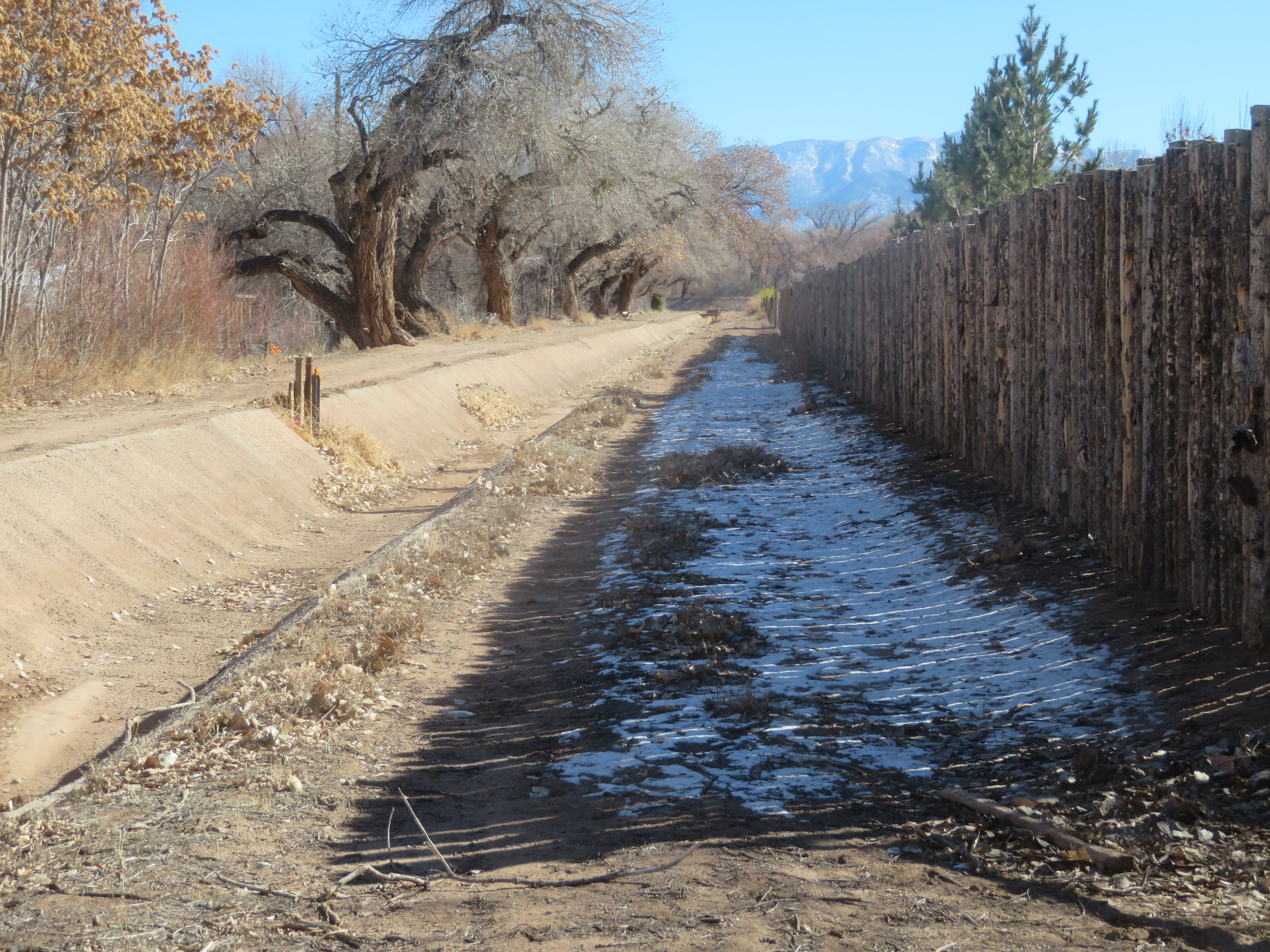
Of course, this is not to say that the forest doesn't have engineers constantly working on it. This irrigation ditch has been dammed by a beaver and the sediment is slowly filling it in. One day, if left alone, this area will become a meadow. But as it slowly transitions, it supports a succession of different ecosystems, each with their different relationships and roles to play. Even the diversity of wet and dry areas improves the variety of places animals can call home. In a patchwork of ecosystems the boundaries are always areas that are most productive.


When the fruit trees at Wagner's farm are pruned, animals move in to investigate. Sandhill cranes like to feed on fallen apples. 25% of an apple harvest that is used to press juice in the fall is waste. This material, termed pomace is often left in the fields for the wildlife. The skunks, porcupines, cranes, and coyotes clear it up with relish.

The Corrales bosque is a hard place to enforce laws, so the local emergency services have to be creative. But no amount of surveillance is ever able to replace the support and vigilance of the local population. Those who visit do not always follow the rules, but the majority do appreciate the preserve as a treasure. Generations of people have lived and thrived in Corrales without the need for any exclusions. But as the threats from outside the community continue to mount in number and risk, it requires everyone to realize we have a treasure here worth thinking about and protecting better.