Translate

Monday, September 11, 2023

Dry


“Autumn wins you best by this, its mute appeal to sympathy for its decay.”- Robert Browning

All seasons have a color. Fall colors are the most spectacular, as the oranges, yellows, and browns soften and mellow everything as greens fade away to be replaced by a different, but ephemeral landscape. Humans could do well to notice and maybe apply the nuances of this change.

Snakes are always around us, but the fall is when they can often be the easiest to see. They disappear quickly as urbanization increases, so are special in places under threat, such as Corrales. This common snake is the hognose. It is a small and very mellow snake that hunts the fallen leaves for the juvenile toads when the day's temperatures are warm enough.
I have talked before about the wide range of caterpillars that there are in the bosque. These web worms are another strange one that live communally underneath a canopy of silk, for protection. These insects used to be treated very harshly with gasoline, pruning saws and insecticides. They persisted and more damage was done to the trees by the gardeners than by the insects. Another way to look at them is that they can only exist in a thriving old growth forest. So their existence proves the health of the wildness that we all seek in our souls when we come into Corrales.
This is a juvenile elm seed bug. It is interesting because this insect, like humans, grow from small adult forms into large adult forms. This is termed direct development. Butterflies and moths grow from eggs as caterpillars and then after a pupae stage become winged insects completely different in form and function from the juveniles in a different process called complete metamorphosis. This is a fascinating area of study because, for example, direct development is common in species experiencing adaptive radiation or coping with climate change. Many animals slowly switch from one growth type to the other, such as sharks that have live young, frogs that hatch as full frogs from eggs, snakes whose eggs can hatch inside the mother, or paedomorphosis in salamanders and even dogs.
In the fall, many insects are facing new changes, such as colder mornings. Stresses in animals increases the susceptibility of infections and birth defects. Something caused this anglewing katydid to be deformed. Even though the hindwings are almost normal, the hemelytra, or wing coverings meant this insect soon died. These insects are also able to shed their back legs, and this one also appears to be missing a hopping leg.
Fall is a season of rodent sightings. There is a sizable population of muskrats south of Alameda along the irrigation ditches where the best food sources are in the cattails and other grasses. They can be very shy, but are not beavers. This one is moving into new digs, because the lowered irrigation level has allowed more real estate to become available.
The human bridges crossing the Rio Grande are habitats perfect for many species. Here are the nests of the summer swallows. Each pot was created by a bird flying back from the muddy river with hundreds of beakfuls of mud, The structure gives perfect protection from invading rodents and cats. Pigeons and bats also hide and breed in the bridge crevices.
I have no idea what this apparent insect egg case might be. They occur in prolific numbers along the bridge posts and I look forward to learning a lot more about them in the future...once someone gives me a hint at identification.
Familiarity breeds contempt, and I am so used to seeing these Say's phoebe, that their return was almost unnoticed. There is always one perched over the water waiting to see a invisible winged insect to pounce on. Soon, the robins, towhee, flickers, and other cold weather birds will be back.
This lucky fish was rescued from a shrinking pool and returned to a backwater of the Rio grande. I'm not sure what species it is, maybe a shiner?
The hummingbirds are still around as the hot weather delays their need to continue further south into the tropics. Their presence makes life difficult for the other birds that have to deal with hummingbird dive bombing harassments.
This is an odd black widow, where the red hour glass pattern has been copied and repeated onto the dorsum of the thorax. I am assured this is indeed a black widow, but I am not yet fully convinced.
With the end of the irrigation season, the spigots have been turned off and the whole man-made structure of ditches have run dry. Here and there, the beaver dams have allowed water to remain and these have developed their own ecology as the fish and amphibians collect in the shallow pools that remain.
Water fowl have begun to return to Corrales from further north, ducks as well as the more numerous Canada geese. They are looking for water; not to drink, but as refuges from predators that can't float as well as they can. Here the Canada geese are looking over their options, but all so far have only rested for a day before continuing south to the extensive protected wetlands available at places such as Sevilleta and Bosque Del Apache
This appears to be darkling beetle munching on a Virginia tiger moth caterpillar. I don't have any context for this picture. The caterpillar is not toxic or venomous, but while the beetles are scavengers, they should be vegetarians...
While woodpeckers are supposed to be here year round, I notice the suet feeders usually go up in the fall around the village as these, and the related flickers move in.
 By all accounts, the fruit harvest in New Mexico is going to be bountiful. Crab apples are related to the edible fruits, but have much less sugar. They seem to do well as an ornamental as well, and feed a wide variety of animals
Grey squirrels should be doing well with the large numbers of sunflower plants dropping their small seeds along the ditches. These animals have done very well by humans, partly because they have much fewer predators now, but also because their ability to eat anything including eggs and tadpoles. Unlike birds, these mammals will be able to glean the sees once the plants have been mown down and left to rot.
The large and impressive webs of the garden spiders shine well in the oblique morning sunlight. The physics behind spider silk is complex, nuanced and not that well understood, but it involves spinnerets and post extrusion processing.
Grasshoppers are perfectly designed for a life in vertically oriented plant stems. Now is their mating season, and the eggs will remain dormant in the soil over the winter. The cold evenings slow them down enough that they can be great food sources for most birds, and indeed almost any critter can eat them. But humans should take the prickly back legs off first. Those stiff spines on the legs serve the purpose of catching in our soft throats if they are swallowed the wrong way, but luckily not many people try to eat them.
The moth at the top of this picture is a Homoeosoma ellectellum these moths are having a bumper year and there are plenty of seeds for them to feed on. The other, bigger moth is likely feeding on pollen. These large flower pads are often a meeting place for many insect species, kind of like a communal marketplace and nightclub for the insect world.
Every dead animal in the bosque often has a interesting story surrounding them. This mouse is out in the open because of recent ditch mowing activity has forced a migration from the resultant loss of  plant cover. How this particular mouse died, I don't know but i would guess it was hit by flying plant stems thrown out by the mowing blades.
The MRGCD is responsible for mowing the ditches around Corrales and this machine does the majority of that work. The population pays around 6 mills to fund MRGCD in its activities which is pretty low as a national average, but it all depends on what you get for the money.
    There are many reasons to mow the wild plants, and there are many thorny issues that it brings up (pun intended). As always. some creatures benefit from the mowing (like coyotes that catch the exposed mice) and others that lose out (such as the small passerine birds in the midst of annual migrations). 
    The biggest of those questions is why have wetlands in the interior drain at all? It has value to some people, but can you quantify it? What is the soul of Corrales worth to all the people? The ditch no longer drains the fields, but people also don't depend on the produce of the land as much. Are tarmac roads and fire hydrants worth more than mud, plants, insects, birds, and animals? The final answer is probably going to be depressing.
    Wetlands are rare and fragmented, and the problem is getting worse as the need for wetlands becomes more apparent. The value of land development becomes higher as more people make do with less space. How many people can look at this picture of cattail fluff and see shelter, food and aesthetic beauty for both humans and the animals in our environment, instead of a tiktok video on "wild corn dogs"?
    We are in the midst of constant evolution of the value of nature. Right now there is a strange alliance of developers and ecologists that causes problems because of the compromises forced on them. Like the Alameda 2nd street drain trail, which is horrifying outcome and does not bode well for the future of the Corrales interior drain. 
As our space decays naturally we have a choice to manage it through those changes, or to redesign it to better fit the needs of the future. The needs of our living spaces are not best met by asphalt, fire hydrants, pesticides, and flat surfaces if that means less nature. Our community decays if there is less wild.


Friday, September 1, 2023

Float

 "It is the glistening autumnal side of summer. I feel a cool vein in the breeze, which braces my thought, and I pass with pleasure over sheltered and sunny portions of the sand where the summer's heat is undiminished, and I realize what a friend I am losing." – Henry David Thoreau
 
Not many people will mourn the loss of the heat and fire risks, and water worries. Still, the sheer variety and size of the critters available to look at is awesome a the heat continues to assail our senses.

Some of the coolest animals are these crayfish. The red swamp crayfish can survive up to four months in dry conditions. This species have also been farmed since the 18th century in Louisiana, even though since 2003 the vast majority of the farming has been done in China. Sometimes this is to feed farmed bullfrogs, who have been introduced from Southeastern United States to farms across the world. Crayfish will often be found traveling across roads when there has been  a rainstorm in the summer. It is listed as a native species according to the Smithsonian, although it is clearly a southeastern species.
Preying mantis are not readily seen for most of the year and there are about ten native species of these summer insects. Others have been introduced to help reduce insects on gardeners pet plants with questionable results. This is the only species of insect that has both a mobile neck, and stereoscopic vision, which means it is the only insect that can look at you over its shoulder, a distinctly unsettling effect.
Large fish like carp should not theoretically be able to  live in the Corrales ditches. However, they are adaptable fish that repopulate areas where water has returned by surviving in refugia, such as the Rio Grande. They can also tolerate high water temperatures and are adaptable, by feeding on many food sources.
The antics of birds will always keep people interested, and right now there is a lot of activity from new arrivals. The fall migration has begun and the bosque is being filled with permanent and temporary fall visitors. This red tailed hawk is surveying the landscape and it doesn't seem to be harassed by other birds, which would be unusual during the summer, at least until the fall arrival of crows.
Red eared sliders are a species left over from the teenage mutant ninja turtle craze of the 80's and 90's. They have mostly moved out of the middle of Corrales and are now mostly found in the southern half of the village from Via Oreada down. This area has permanent water under overhanging Russian Olive trees, which they and the beavers seem to prefer. This water tends to be acidic from plant acids, and looks black because there is no clay to tint it red/brown.
The last of the wet weather has left for the near future. All that remains of the wet that fell from the sky are these distant pink and purple clouds at sunset.

Many trees are really just a thin skin of sugars at the innermost layer of bark. All that heavy wood is a scaffold that allows the leaves to get higher than the competition. It is well known that many trees will grow back quickly as bushes when they are severely pruned. A tree grows by producing new cells from its roots and its branches. The root produces cytokinin hormone as it lengthens. The branch tips produce auxin hormone. Apical dominance is the term for when trees use the large relative amount of auxin in its tissues to sense that it should focus normal growth on the branch tips. When a tree is cut, like this one, there is no more auxin produced. The heavy imbalance releases the suppressed effects of the cytokinins. These hormones activate new growth centers, called lateral and epicormic buds which had been prevented by the presence of auxins until now.

This picture shows the new growth of what will become the new trunk of a tree from a nascent bud of the living cambium, now released from the confines of the strict controls used by nature by a human need for control.

Dragonflies are creatures of heat and light that do not do so well when it is dark and cold. In the evenings after a rain, dragonflies are so sluggish they can be picked up easily for study.
Many other insects prefer to collect under the lights of human habitation at night. Apparently this is due to their lunar navigation system being overwhelmed, but the story is much more nuanced than that. This is a species of nocturnal wasp which occur in much larger than realized numbers in the deserts around here, especially when there is a lot of moonlight. However, these insects are not well studied.
The bosque has a lot of lizards at the moment, the two most common species are smaller than those found in the open deserts. This is because smaller lizards can support higher population densities than large lizards can. Lizards survive by manipulating their environments, such as staying in the shade on hot days and sunning themselves on cold days. Snakes and other meso-predators are less present (during the day) and so lizards can be more active once mammals such as raccoons and skunks are avoiding the heat and humans. Whiptails are active hunters and flee into the underbush when threatened. This is one reason for their smooth scales and streamlined body.
Fence lizards are ambush hunters, resting on a look out spot for insects and predators. They specialize in short bursts and tend to flee up a tree if pursued. They have spiky, keeled scales and long toes that help them blend into rough bark and grip firmly.
Microclimates are important for seedlings to thrive and it can be difficult for plants to find their best growing conditions. Here, the shells of the cottonwoods provide moisture and nutrient rich mulch, while the ants appear to be providing aerated soil.
Spurges, as well as purslanes and puncturevines grow well in these autumnal conditions and are fast growing ground cover plants that can often smother other plants. The name of the spurge family refers to their use in the middle ages as a purgative.
This juvenile coopers hawk is sheltering in the branches, as another coopers is circling above. The bird is both agitated and interested in the behavior, so I am not sure what the behavior actually is. It could be a fledgling and parent, and is probably not courtship or territorial.
The ditches are drying out as the available water is going below ground. So the crayfish are having to dig for shelter and oxygen (they have gills under their carapace so can't dry out)
 Caterpillars are beginning to find their favorite plants have started to lose their leaves. Also the plants have begun to sequester nutrients back into the roots as the first stage of abscission. So many insects will begin to migrate or pupate into winged insects better able to migrate. Here is a tiger moth slowly moving to another plant in the bosque.

Other caterpillars are gorging on the remaining leaves as fast as possible, fattening up before they metamorphose. These are a patch species of butterfly, probably Nymphalis antiopa, or mourning cloaks feeding on sunflower leaves. This species uses diapause to delay development, although this is a late time of year to emerge.
While the larval stage of the common blue mud dauber is a carnivore of black widow spiders, the adult mostly consumes nectar from flowers such as these sunflowers. There are many beautiful wasp species found in New Mexico.

 New Mexico recently had a very bright full moon at the end of August. The next full moon will be the official harvest moon as the Fall equinox begins. However, most of the changes that will occur have already started in their nascent stages, so in many respects fall is already with us. I wonder if we will miss the vibrancy of those summer insects and amphibians once the days are short and cold.
 

Monday, August 28, 2023

birth

 Some plants become weeds simply by virtue of their success rather than any other factor. You merely want less of them. - Monty Don (Gardeners world)

    This beautiful flower belongs to Tribulus terrestris. Humans have been protecting and nurturing this plant since before language itself was invented. We have changed the climate to make the habitat more suitable, we have eliminated its competition, and prepared the soil exactly how it likes it to be. Finally we have adapted its behavior to allow it to grow faster and be more hardy by weeding out the less preferred types. We have even toughened it by spraying it regularly with herbicides so that it can develop resistance to more spraying. This plant is the dreaded puncture vine, and we are at it's mercy.
    I heard once a gardener complaining that everyone needed to pitch in and weed their gardens to eliminate this "menace". It was an odd thing to say, given how hard we work to power this plant through evolution. The species gets gets tougher even as the cloistered red roses, and blue grasses become more and more fragile under our selective breeding practices.

The thick weeds we have right now are a boon for many insects. Some of the lesser know ones include this hairstreak species (named for the fine wires on the wings to confuse predators). Bees flock to the rich pollen of the ragweeds that so irritate human nostrils.
Tree crickets are hard to see, even if they are easy to listen to. There has been an interesting discussion regarding the use of "less preferred" males to improve their songs by "baffling" or artificially amplifying their stridulations using leaves. Basically, the evolution of the use of tools and the effect this has on insect evolution. That small brain can being pretty smart with the right motivation. This is a large, confident male, based on the position gripping the edge of a leaf with engaged in a chorus.
Chrysochus auratus, or dogbane beetle is a spectacularly colored insect that feed on the poisonous sap of milkweeds and dogbane. Both these plants are slowly spreading from the south of the Corrales Preserve into the northern reaches as the shrubs and graminoids gradually replace the canopy of trees.
Darkling beetles should be hiding in the duff formed by dead tree leaves, but when it rains, they can often be found on the stalks of tall herbs like the bee blossoms where they appear to be feeding on flower nectar. Beetles and other insects seem to prefer to congregate at this time of year on large flower heads such as sunflowers.
This beetle looks like a wood borer but actually feeds as a larva on the dead roots of the mallow and adults can often be found on the plant. Those long antenna not only taste, smell and feel, but they also have other sensilla, with up to twelve different types of receptor.
Ant-lions have tiny knobs instead of antenna. These vaguely dragonfly looking insects look very different that the fearsome larva that thrive in dusty bowls flinging projectiles at nearby ants. Once there is the hint of rain, and all those cones of dust become useless, many metamorphose into winged insects like this and migrate to mates and streetlights.
The flow to the Rio Grande has been turned off, literally as many issues with water storage upstream at El Vado dam and the Corrales Siphon has eliminated the steady water release that we use to try and turn our intermittent flows into a predictable low sediment, eastern river. The many pools, sand bars, and woody debris is a novel ecosystem that is quickly exploited by different organisms such as cockle-burrs and coyote willows.
Residents of Corrales often exploit the ditches as drainage. Often pumps are used to lower a water table locally prior to digging a below ground pool. This often leads to increased vegetation in subsequent years as dormant seeds in the soil become activated. Hopefully, this water is not contaminated, but because no one tests groundwater, this is never known.
There are many apple trees bearing fruit and there are many animals ready to exploit this sugar source for food, as well as housing. The codling moth is eaten by ants and wood peckers and likely responsible for many types of fruit evolution, such as stony pits and fuzzy fruit skins. The codling moth causes premature fruit ripening by pausing apple growth when they bore into the seeds. Many parasites change the behaviour of their hosts in what usually ends up being s symbiosis over a long enough time span.
Bullfrogs usually prefer deep pools of permanent water, so are a little less abundant when the clear ditch dries out. These huge frogs are smart and adaptable to most things and many have returned to the river's edge from the ditches around Corrales.
The saltwater tamarisk is a messy plant that had transitioned from an invasive species to a mandatory habitat because it has been so successful. At this time of year they are putting out the showy pink blooms that are loved by bees, wasps and beetles.
Molluscs are rare in New Mexico, except for these land snails which have traveled around the world hitchhiking on people's garden plants as they  move from one place to another. Local roadrunners have developed quite a taste for them. They are rarely seen except during periods of high humidity.
Common snapping turtles thrive in low water conditions and this one is hunting as it waits for fish to travel down the clear ditch into it's waiting mouth.
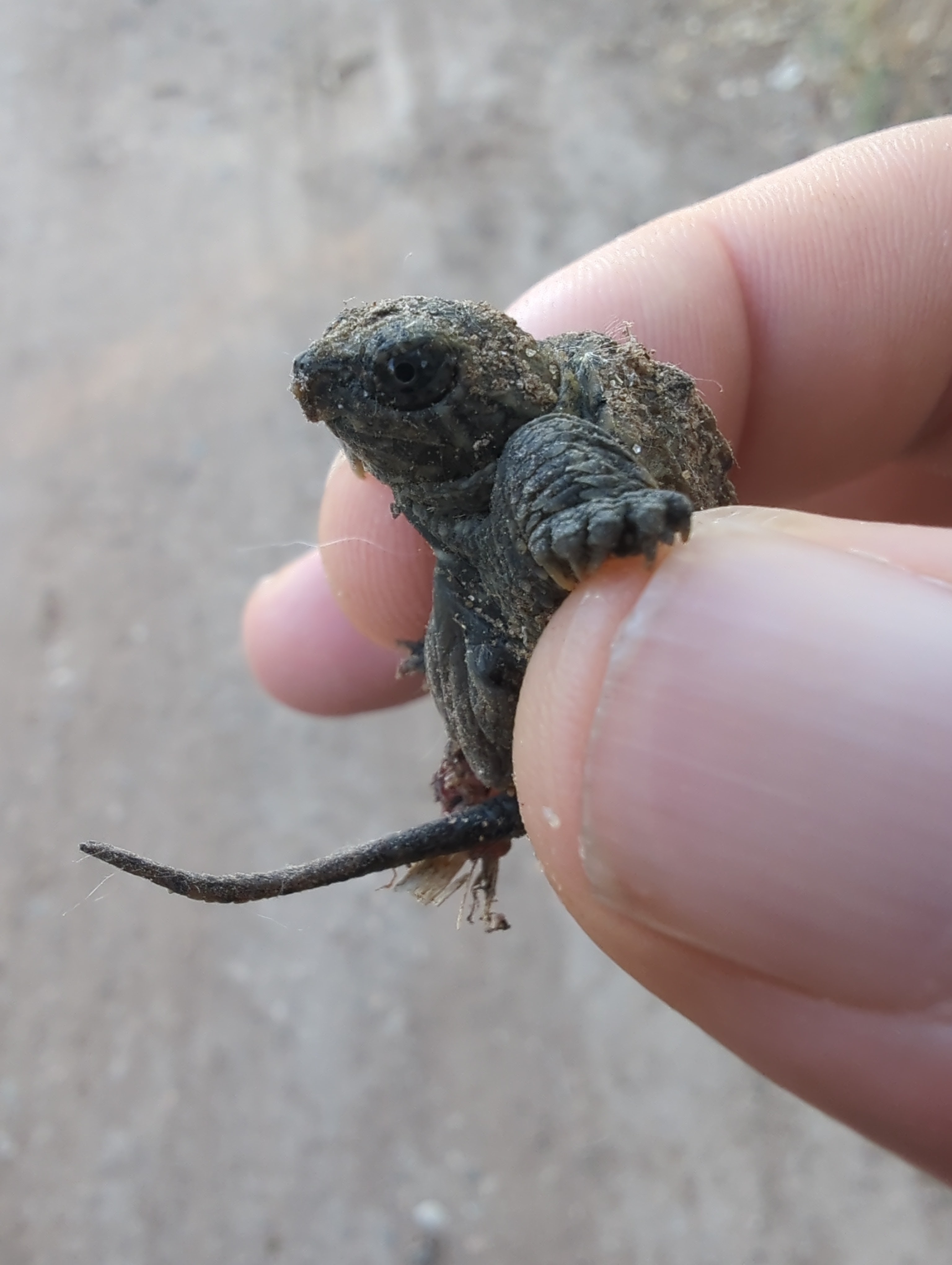
The young turtles are incredibly cute and delicate. This specimen has only been out of its egg for a few hours and is still covered in the sand from it's underground nest. It will be a while before it has grown big enough to dominate the flora in a local pond. Snapping turtles are a highly successful species that appears to be increasing in numbers as the local cattails help to hide them in the thick mud.