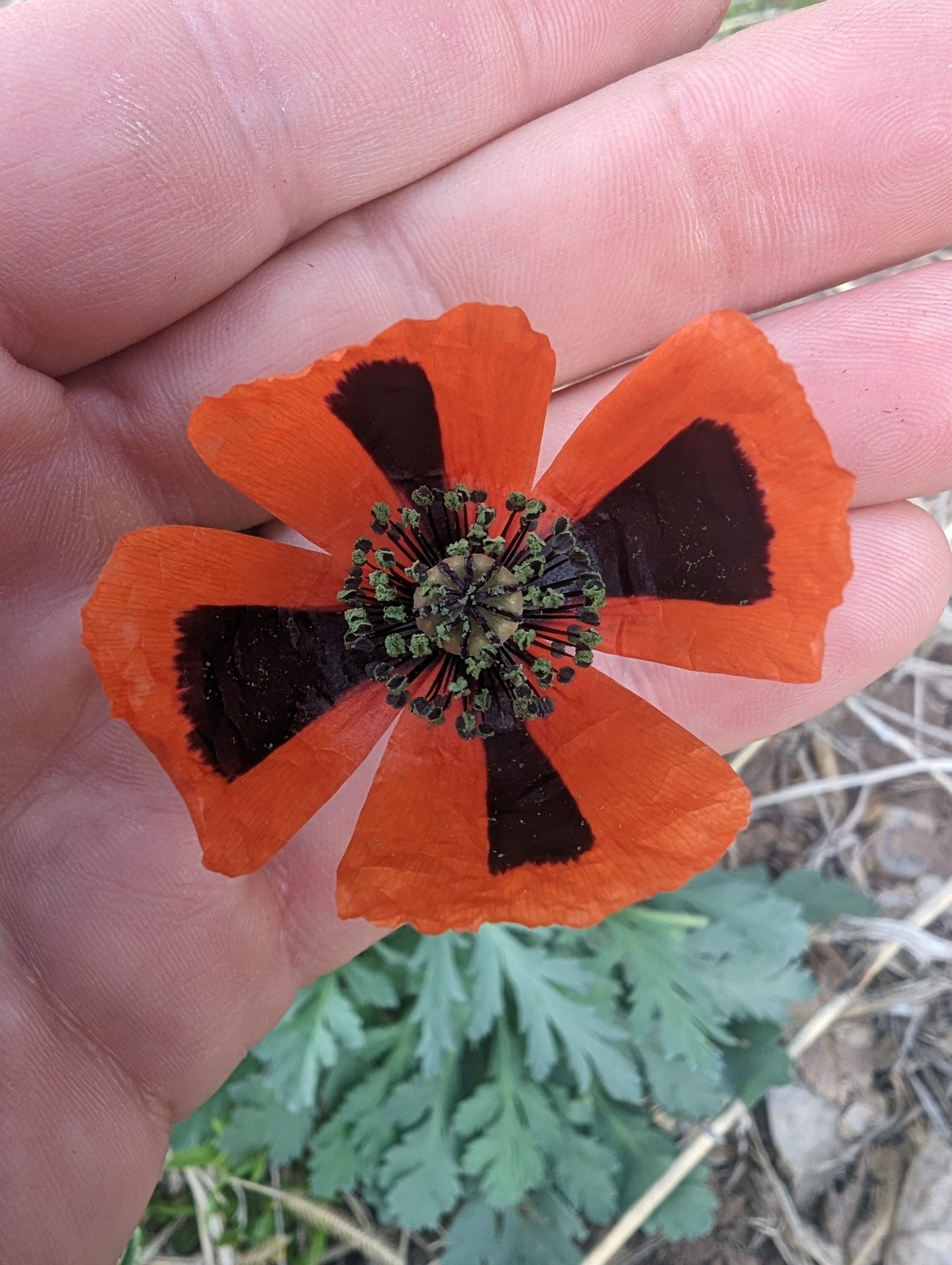
Flowers are not designed to be attractive to humans. Because humans are so sight centered we appreciate many of the same signals that have evolved to appeal to insects pollinators, this appears to be purely an accidental side effect. Of course, the story is far more nuanced than that, but you get the idea. Over time plants, humans, and nature in general builds up a range of co-incidences that makes the intricately fitting jigsaw that is the world around us.
Asters are a widespread group of plants whose blooms are mostly general purpose, open faced, and appeal to many insect pollinators. They are a complex plant however, than has evolved to exploit many ecological niches.
It is hard to research poppies because internet research talks about literally nothing else but the opium poppy. However, bumble bees and honey bees go crazy for this flower because of the huge amount of pollen this flower makes. This flower is perfectly capable of self fertilizing, but sexual selection allows better evolution through recombination. The bright contrast and reds appeal specifically to bees and flies.
Just about all flowers need to have a bilateral symmetry. This has something to do with the horizon detecting eyes that most flying pollinators have. Also, symmetry is a good sign that the plant is young and healthy, because asymmetry likelihood increases with age as blemishes from insect attack, disease, or anything else damaging shows clearly. Periwinkles recess the nectar part of the flower, which increases the likelihood insects will transfer pollen where there is a lot of competition for attention from other flowers.
Bindweed are a climbing vine with short lived flowers that are attractive to moths. Symmetry is a lot less important to night pollinators and flowers that are ephemeral. these flowers close during the day to limit access to general pollinators that would waste the flowers resources. The tube structure also appeals to bumblebees that can sometimes force open the petals during the day.
Plants that can attract specialized pollinator groups are more effective at pollen transfer because those specialists visit only that species of flower, allowing statistically faster fertilization, important where the growing season is short. A fused corolla (tube) forces only those insects with long tongues to visit and is a sign of the evolutionary arms race between pollinators and flowers that quite puzzled Darwin.
Many birds use color, like this red shouldered blackbird sporting contrasting epaulets. Their musical songs, flashy displays, and bright colors work because the risk of being eaten by a predator is lower than the risk of not mating where there are many blackbirds in a small area like a wetlands for only part of a year.
Yellow breasted chats are usually very secretive, so I was happy to find this one out singing its very distinctive song. Birds have
a unique one way breathing system that uses air sacs in their bones and one way valves to use each lungful of air twice. This is not only effective for flying, but does extra duty by allowing them to use circular breathing for songs.
Great Blue herons seem to be far more understated when it comes to courtships. However, they grow special breeding plumage to show off to the opposite sex, which they sport until around June. You can just make out the special pair of thin feathers sprouting from the back of this heron's head.
The point of all this courtship is to produce the following generation. The most enigmatic chicks are usually the great horned owls, AKA "murder floofs". We are usually lucky enough to watch a brood each year fledge their chicks, normally one chick survives to adulthood. This chick is just about to lose its downy plumage and collect the first flight feathers. Notice the distinctive horns are now just tiny nubs.
This is the same chick, but now much more confident. While it can now fly, it is depend on its parents for food for about another nine months as it figures out how to hunt for itself.
The flooded bosque means small mammals are often flushed from their burrows and exposed. This vole is headless and left in the middle of a path, indicating the predator likely was already well fed and was probably a horned owl.
Mammals are plentiful, this young cottontail is unsuccessfully trying to hide by freezing after being spotted in my backyard. I shooed it back in the hole it came out of so mom could give it a few more lessons in survival.

Insects are also growing rapidly. Many use the method of just producing far too many young for predators to eat at one time. Many insects like this swarm of aphids can clone themselves, covering a lot of generations in a very short period of time.
Spiders are an interesting insect to watch in the bosque because there is so much variety of species and behaviors. This may look like a black widow, but is more likely a closely related species of cobweb spider and completely harmless, as they all are.
This spider goes by the horrifying honorific of giant wetland spider, and she is also zealously guarding her newly produced egg sac. This fearsome looking spider is also not a danger to humans.
In the bosque, many spiders are actually at risk of being prey. Not only from other, bigger spiders, but also from wasps that lay eggs inside their body after chemically paralyzing the arachnid. This wolf spider is taking a risk being outside its ambush burrow.
Moths rely on many tricks to avoid being predated on. This one looks exactly like a twig when it is not moving.
Normally, this cutworm would blend into its background of leaves, however the windy weather brought down the branch this one was on, necessitating a scramble towards the nearest tree trunk.
There are 100,000 species of wasp and they are very diverse. This one was resting in the weeds, I am still working on its identification. I know there are going to be many more species coming out in the coming months.
This tiger swallowtail looks dead, but actually made a full recovery after warming up and resting on a damp apple slice for the morning. These huge, colorful butterflies visit our bosque, but never seem to be around in large numbers.
the checkered whites are a small butterfly species, they specialize in feeding on mustard grasses and often can be seen anywhere these plants grow in profusion.
Most moths pupate in the soil, but most people do not find their cocoons in the dense leaf litter, it is even harder to find the adults. This is some form of euclidia moth, blending in perfectly with the cottonwood leaves.
This is the larva of the yellow ladybird beetle. Ladybirds actually come in a range of colors but they are all predators of soft bodied insects like aphids. The adults have special interactions to deal with the ants that often protect the aphids including bleeding toxic chemicals from their leg joints and a shiny domed body that is difficult to grip.
Many insects are invasive and compete with native species. This is
a native rough stink bug, NOT the invasive Marmorated stink bug that occurs in much higher numbers and is considered a pest. These insects also just just like squash bugs, but are a very different insect.
This is a young zodion (fly) species. People do not appreciate how important flies are as pollinators, or how perfect they are as fliers. Flies have a pair of special organs know as
halteres that help them control flight and is different than normal insect wings. They are true masters of the air as anyone who has tried to catch one with attest to.
Turtles are impressively adapted to life in water, some are adapted to slow water, others to fast water. Deep or shallow water have different types of tutle shapes living in them. Each body type is designed differently for their unique environment. This common snapper is designed to be big and burly, a slugger that can scavenge or hunt and defend itself from most things in its environment.
Other animals are not designed for some environments. While whiptail lizards can swim, they will drown if the water is flowing, usually because the cold water saps their energy quickly. They have enough skill to dart across reed filled puddles to escape predators, however.
Many skunks seem to get caught as the ditches fill. Skunks tend to have a pigheadedness about crossing whatever is in their path and this often ends badly for them. They can swim well to cross ditches, and they often do this during their evening rambles, but I usually find at least a few that drown each year. Scavengers such as the turtles dispose of the carcass eventually.
The beauty of Corrales to most people is the serene walks along the "canals", ditches or acequias. This water has been carefully managed and conserved each growing season since the early 18th century (probably longer). Many people appreciate the taming of the river, even as they fight to change the future of this valley to allow more, or less people to live here.
Water from the river is always trying to take back real estate, too. Right now the river is making large sections impassable to humans through backwaters, rising water tables, mud, and mosquitos. The willows are saturated right now, creating perfect habitats for many species such as toads and water fowl.
This land that is off limits because of the high water levels will sprout new cottonwoods in future years, if they survive. The unpredictable river banks allow forest rejuvenation over several years, reducing invasive plant spread and letting the bosque pause in the drastic changes that continue to sweep across it. It is fascinating how the lack of access to the river banks that casual users complain about, tends to to be the same things that allow the best of the bosque wildness to shine. This is just one more example of the complex mix of random co-incidences of co-existence that allows all these organisms (and different people) to exist together.