Translate

Friday, January 14, 2022

green

 The weather is already warming up and many signs of spring are around for those who look. We still suffer from very dry and windy conditions. The perfect conditions for a forest blaze, so everyone needs to be extra vigilant walking in the bosque.

 The Heron is also looking around. The blaze of white feathers on the chest is usually easy to spot. Now that nesting season is beginning, many smaller birds will begin to harass these risks.  A heron will possibly eat nestlings, so is often targeted by medium sized bird pairs. Crows can be observed harassing hawks along treelines on Loma Larga now. The worst offenders are the kingbirds later in the spring. Then the hummingbirds make life difficult for the larger birds in the summer.
The heron are usually seen being stationary, so I thought I should prove they do sometimes move. This one is in the shallows hunting mosquito fish. Those fish are active as the water warms and are feeding on the plants and animals in the shallows. They in turn are preyed on by bass, and herons.
 
Beaver have become more active. Of course this has to be inferred from their activities as they remain very shy. The most iconic signs of their activity is their gnawings on trees. Medium sized trees like this are felled so that the beaver can reach the upper branches. Although it really does seem like the beavers like to fell the largest trees just for the sheer hell of it.Cottonwoods are preferred over Russian olives, but both appear to be felled for building materials, as well as food. The color of the cut wood changes from orange, yellow, white, and then weathers to a grey/black. This trunk was felled about a six months ago.

Beavers build dams on small tributaries to create marshes. Humans do not like to live in a marsh, so beavers were turned into hats. Obviously, the story is more complicated than that, but that was the result.

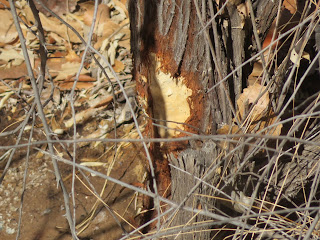
 There are still plenty of beaver and muskrats around, though. Just look in the backflow at the river's edges for the telltale white sticks with "V" shaped ends. The flash of white is known as a blaze, from the days when trails would be marked by bending green sticks, or cutting into tree bark to indicate a trail
Most of the shrubs have flowing sap and have become pliable. The white heartwood is surrounded by oranges and greens of moist sapwood. The delicate parts are coated in the the grey and browns of the outer bark. This is the food of many mammals in the bosque.

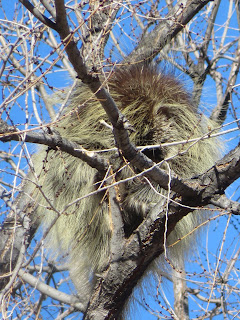
Looking up in this tree, you can see the tell-tale signs of the porcupine. When chewing on the sticks they leave a white "blaze" of the heartwood in sections. (The ball of the sleeping beaver is to the right side of the picture, more camouflaged in the "Y" of the tree trunk).

Another clear give away is the pellets of sawdust beneath the trees where they are snoozing during the day. They look like little cigars to me. Others say they look like Russian olive berries, or elk scat.

 Porcupine prefer young trees in thick cover for food, moving to the bigger trees with good forks in the trunk to sleep in. The next generation of cottonwoods do exist in the willows, but are far fewer than they used to be because of the changes in river flow. The actual story is pretty complex, and not well understood. It is pretty clear to me that young cottonwoods need to grow in coyote willow swales to survive, for whatever reason.

Cattails have begun shedding their white puffy seed coats into the wind. Bizarrely, I have found cottonwood seed drifts as well, but have no idea when they could have come from. Plants still have their secrets.

West facing ditch slopes are icy for much longer periods of time. Everything is still dormant from the lower temperatures. But the ice means they should be moister for better growth during the summer.
Where moisture isn't an issue, in the mud, the green growth of plants is already well underway. Grasses and forbes are sprouting from soil seed banks and taking advantage of abundant sunlight and relatively little herbivory from insects and birds.
This white blaze shows where a bird likely investigated a pre-existing burrow for insects, or maybe is planning a nest for itself. The puddle of water in the den means this is not likely to be a mammal's den. Often bullfrogs are found here taking advantage of the extra warmth in the sun.

Dense undergrowth favors the smallest birds who can navigate the three dimensional trails and hide from predators at the same time. This sparrow is stopping for a drink as it hedgehops down the ditch looking for all sorts of types of food. I have watched them eat hamburger meat from the vultures at the zoo. Others can drink blood. Suddenly they don't seen so tame, huh?

The world of birds is well know to this species; a birder in his natural habitat and cradling a lens the size of a large salmon under his arm.

 Those lenses are not just for show, either. This picture shows a blur that was my first sighting of a great horned owl this year. They say the best camera is the one you have with you. I had my cellphone...praeparetur. The skunks are out one of the prey items this owl is looking for, but I have only smelled them so far. The first of the crickets are chirping in the evenings. the horned owls will be nesting very soon, if not already.

My resident boxelder bug is still wandering around the kitchen, luckily it appears to be alone. I hope it stays that way, but they are not really the pest the bug control companies would suggest.
Most people think they know about spiders, but do they know about those that fish at the edges of streams in the dense grasses? A several species of wolf spider can dart out into the water to snag unwary insects that are flushed out by creatures patrolling the edges, such as dogs, raccoons, and people. The spiders occur in surprisingly large numbers in marshy edges of slow streams.
This fly appears to be a Hydrophorinae species, but the internet did not provide much helpful information on it. Bare silty mud banks are ideal locations to breed for many winged insects.
Here is a tiny field cricket. The young have just hatched and trying to survive in the wild. By the fall most specimens will be pretty large and tough. This one appears to be trying to swim, crickets have a well known aptitude for drowning, which at least one parasite takes advantage of.

Another huge risk is smoking. I'm not taking about the lungs, even though that is so well known it's not even worth arguing about. This white stick shows someone in the bosque though a lighted match was a good idea to carry around. I honest can't believe we have not had more fires than we have. The Corrales bosque is great for birds precisely because it is heavily overgrown. We have had record setting dry conditions for several years now. The whole bosque in our section is a tinderbox, just like Cedar Crest is in the mountains. I wonder everyday how much longer the people of Corrales can keep being this lucky. It won't be much longer if there are people walking around in the firewood with actual lit coals under their noses... After the 2003 fire in Albuquerque, a massive tree thinning program reduced the future risk of fire, but also removed most of the birds that lived south of Alameda bridge as well. Another form of blaze that is very uncomfortably close to home right now.


Wednesday, January 12, 2022

Mud

Seeing value in the land can take many different forms for different groups. For most, the land is a place to put a house, a commodity to buy and sell. But others use land to grow produce, maybe even for their own consumption. People don't forage anymore, but many animals also use the land to meet their own  needs. In many cases animals are in the bosque to make a living, usually from the mud.
The sandhill cranes love the cold mornings and there is a lot of activity as the sun's rays start to warm up the land. These big birds like the clear water and fields around Corrales. They are never found in the irrigation ditches, however. I think it's because they prefer to be able to see around them. It's odd, because the similar sized herons have no problem fishing from the ditches in the morning
The nightly freezing temperatures combined with the very dry air to make remarkable patterns in the mud. Corrales has has permanent agriculture for longer than other parts of America (11,000 years). Notice how the stones in the above picture are being slowly lifted by the freeze/thaw cycles of the soil. Often small objects like pottery shards, arrowheads, and small metallic objects will appear in the cultivated fields on spring days.
The interior ditches are not needed anymore for draining the marshy land, but they are still ready to carry off excess moisture during extreme floods (which the western US is known for). The cattails heads are slowly releasing their seeds on the winds, and the dark black mud is slowly coming to life. In the bosque del apache reserve, the cattails have to be cut then burned. In corrales we are not quite sure what to do with them. other than remove the water.
This Oily sheen is slowly turning to rust as it is exposed to the air. Many swampy areas have this rainbow in the water where bacteria is digesting manganese oxide back into iron and manganese. The raw metal is literally deposited as a thin metal film on the water surface.

Right now, the gardeners are preparing for the spring planting of "winter annuals", which is one of those quasi real terms that garden suppliers use to control their clients spending habits. It's worth bearing in mind the average gardener household spends >500 dollars a year on supplies. There are >43 million gardening households in the US....do the math.

All those new plants coming into New Mexico dropped off a few hitchhikers, like this slug I found. Likely a juvenile grey slug, as those stay active in the winter.

The slugs are sought out by the sandhill cranes in the wet meadows during their migration. In Corrales, those birds will substitute farmed fields and eat roots, dropped corn, and various insects. In this picture I also found a beetle larva(?). Underneath wet logs is a very protected habitat and a perfect nursery for all sorts of delicate organisms.
The bosque is heavily used by Canada geese, who travel every day to find gardens of short, manicured grasses. The actual river gives the geese protection from ambush predators during the evenings, but the birds cannot eat there.

Cranes are much more generalist and seem to be able to consume just about anything you can imagine. They also like to use the river channel for protection in the evenings just like the geese. They are very immobile until the flock takes off in the mornings after the sunrise. They seem to leave after the more excitable canada geese have moved on to the feeding fields.

This untidy pile of sticks is probably a crow's nest, based on the fact that this section of the middle ditch often has a small flock nearby. I think they are attracted by the nearby pecan orchard in the area. The numbers of crows and raven that flock in to the bosque each sunset are pretty impressive, but the mated pairs prefer to be away from the raucous rabble.
This large lumps looked like another nest, but was something altogether different. When a tree suffers an injury, it often responds by creating a scar. Known as a "burl". Normal wood has directionality that gives it strength in one direction. Usually this is laterally and circumstantially, but not radially. In a diseased section of a tree, the wood grain is all over the place. This gives the wood increased strength in ALL directions. This makes burls very sought after by wood workers carving bowls and spoons that won't split. This is a much more specialized market than it used to be.
Annuals sprout from seed and usually have to grow fast. They start early, grow fast, and drop their seeds before most of the bosque even has greenery. This London rocket is taking advantage of moisture found under some cottonwood leaves by the trail in a warm, sunny spot. The young leaves have a very nice, peppery flavor.
The herbaceous brassica species will be long gone by the time the pigweeds and Russian thistles have turned green again. I'm not sure what this mower is trying to control on the levee. But humans have a long history of doing things that seem contrary. Quite likely they are simply contracted to keep mowing until the bird nesting season prevents further work. Not quite "in tune with nature" but it provides a livelihood.


Saturday, January 8, 2022

Food


Food, and  feeding animals especially is a complex and often misunderstood subject. Often this is because different groups of people have different ideas about the basic concepts we use to discuss the issues. As spring-like weather conditions begin in the Corrales bosque, this bears repeating for those of us nature watchers who see changes coming.
Often,biologists tie themselves in knots trying to categorize animal behavior into "courtship" or "territorial behavior", "feeding", or "socializing". Watching these white winged doves at a bird bath I think the activities would be basically "flexing". They are all on the dance floor, and later will pair off as the party winds down, so to speak. Bird feeders are very popular during the winter, and allow the support of a large number of social birds. And by social, I mean, of course, bossy brats.
 
 
In science, to observe something clearly is to categorize it into something with well defined attributes. Something is, or it is not. But life can be messy. This crow is very handsome, and acts smart up close. But they are also messy, noisy and pests as well. This not a "good" or "bad" thing. It is just something to be observed. Notice how the other crows are waiting to see how this french fry transaction goes down before making any more plans. This is a different sort of bird feeder, not socially sanctioned by the city of Albuquerque (although only feeding city pigeons has a city sanction)

Shelter and food activities are so intertwined I feel they should be considered one term, maybe "homesteading"? Along the clear ditch there are many burrows, some new, some old. Many are made by muskrats and other rodents, and are then borrowed by shy, reclusive birds such as snipes, woodcocks, avocets, rails, sandpipers and yellow-legs. Most people will never see these mud feeders because these birds don't advertise themselves. Even most birders will wait for an observation to pop up on a popular birding program before flocking to a documented sighting to get a sought after a "lifer" for a "checklist". A good birding camera is about $1500 and a good pair of binoculars costs $300 so individuals take this hobby seriously. Most of these kinds of birds appear on birding lists around February and it takes real skill, luck, practice, and some determination to find them.
In the spring, you should see a lot more burrows of the Botta's pocket gopher around. This hole is likely from a male looking for a female's burrow. These gophers are otherwise very antisocial and quite fierce for a furball only 10 inches long. This hole was quickly plugged after a day, apparently no females in this area. An open burrow is good for surveillance, but invites too many visitors. Still, the risk of a home invasion is pretty low during the winter months.However, I know of at least one gopher snake that is hibernating at this location, and they have that common name for a reason...

Homesteads come in many forms. In the winter the old trees often shed branches after a freeze. Not only does this open the interior of the tree trunks for nest cavity builders like owls, but the sections that fall can open areas of the canopy when the forest is very dense. This allows new growth to take advantage of the light. This phenomena is well studied in the Pacific Northwest, but is also relevant in areas of dense mid story forest cover in the southwest, like the Corrales bosque.

Old trees are of no interest to loggers, or others natural resource industries. Hardwood trees in the desert southwest are even less in demand as they grow crooked, small and are full of fungus and imperfections. This cottonwood stump in the bosque as a great maze pattern caused by weathering, beetles, and fungi. The outer bark shows burn scars. This tree supports a lot of life, even after it died.
 
 While silverfish are still know as "pests" I would suggest that most houses are not the damp, cold places they were in Victorian times and do not often have moldy books and old fabrics like wool, cotton, wallpaper and silk lying around on the ground for silverfish to infest. This insect is sometimes found in old tree stumps and has the rare distinction of being able to digest wood, and pretty much anything else organic. It is also able to live for a year without food, if necessary. A true survivor species.
  
This is a non biting gnat genus Chironomidae. They will start appearing as soon as the temperature is above freezing at night and the ground is damp. I think they must be the first active insects of spring.They form a buzzing swarm of males to attract mates. The eggs are then laid in water. Many small birds like phoebes eat huge numbers of these insects, catching them one by one in their tiny tweezer-like beaks.

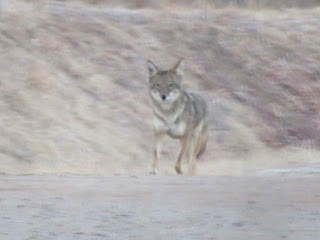
Coyotes have got to be the most polarizing wild animals in Corrales. It feels like no one wants to admit that these canids cannot be controlled, or that they are also anxiety provoking. On the other hand, humans will always attract coyotes as long as we continue to have livestock and pet owners. Food to a coyote includes fruits and vegetables, as they are omnivores, unlike those sneaky bobcats that prey on people's chickens. There is a den nearby that has 2-3 adolescent coyotes that are just learning about daytime, cars, domestic animals, and dog-walkers. This is the shy one. It just watched me this morning, learning what it could. Their mom has begun the process of abandoning them, and they are likely on their own now. This means this is a male, as the females stay with the pack.
This other coyote sibling was the more opportunistic one, but likely gets into more trouble. It was trying to get back to safety, but I was in the way, so it had to run past. No aggression (unlike most dogs, and dog-walkers) just had places it needed to be. Coyotes feel ill at ease in the daylight, as they are prey animals often hunted by wolves, mountain lion, bears, but mostly people. Over 1,000 coyotes are killed daily in the US. No one seems to know how many coyotes there are, but as long as humans kill their competitors, open the forests, and provide foraging opportunities, they are going to be around.
Everyone loves this big, dumb bird. Mostly because of that wonderful ruff of feathers on it's neck. While they are known for fishing, herons will also hunt gopher, mice and ducklings. Animals are not choosy, even those that are strictly carnivores, like this big lug.
I find this picture so odd in many ways. This is an introduced trout. These cold water fish are pursued relentlessly by people throwing fishing hooks into the water, and throwing trash everywhere else. The trout themselves alter ecosystems by eating everything else and harassing what is left. This particularly unlucky fish likely suffocated after a fisherman crushed it's delicate gills by rough handling. The government breeds more to replace them because anglers do pay (about 268 million dollars a year in NM!) for the privilege of fishing, unlike the majority of other non-lethal outdoor enthusiasts. In warm weather the trout die off if there is no deep, or fast flowing water, as the warm water cannot hold enough oxygen for them to survive. Salmonids, like trout are a fascinating area for study and depend on clear, cold water to thrive in the wild. This encourages investment in conservation efforts. This trout is likely going to end as a meal for the crayfish that are beginning to return to our waters after the recent drought.

Monday, January 3, 2022

black

Spring frosts seem weird to have in the middle of winter, but most of biology responds to temperature cues, not human timetables. Humans are certainly involved in climate change, but to what extent, and how this will manifest in our lifetime is less clear.
The winds in central New Mexico tends to be very low humidity. We also have a thin atmosphere due to our altitude. These two effects together mean we rarely get moisture coming in from the north. When we do, it doesn't stay long as snow. This beautiful picture of the snowy peaks will disappear quickly.
 Here is a picture as the peaks were still actively getting their snow (and trapping 21 restaurant employees on icicle shrouded wires for a day.)
Any time the temperature goes below freezing, we are going to see frost cracks like this in the packed clay. If the surface is uniform, this pattern often looks like a beehive, as a series of hexagons. The process is subtle in Corrales, but can get pretty bizarre in other parts of the world that have periglacial conditions.
 Roads in Corrales are necessary, if often unwelcome. They place a tough, impermeable surface down that then allows our steel boxes on wheels access to everywhere. However, roads are not the panacea people would think. They have a lot of problems that go along with their great improvements in fast access. Here, the constant temperature changes during the winter causes thermal cracks to form across the width. Especially in tree shaded areas like in this picture.
 This crack is longitudinal, and started as an unequal level between two successive layers of hot mix asphalt. Water collected in the seam and eventually froze there. By a process of frost heave the rocks are separated from the binders and removed, leaving behind a hole in the road.
 Here is an example of a tunnel under the road forming a crack and subsidence. This was caused by an underground wire being dug under the road, in this instance. This is eventually going to become a major headache for someone (else). For now it is just a small series of potholes.
 This big pothole in a unpaved road is quickly formed, but also quickly repaired by simply adding sand or clay to displace the water.
 The sandhill cranes seem to prefer feeding right after a hard frost is on the ground. They also retreat to the shade when the sun comes out during the day. They really seem to prefer cold weather and have looked distinctly uncomfortable during some of our warmer winter days this year. This pair are preening together while waiting for the cracked corn to magically appear from out of the neighbor's feeding bins.
The crows come into roost during the colder days. We seem to have urban and rural crow groups. The urban crows roost and feed around the pedestrian malls and fast food sections of strip malls on the edges of the city. The rural crows feed and socialize at the municipal open dump sites and number many hundreds of individuals. They appear to choose a different location each night, probably to avoid too much attention from the humans below them. I have not yet need much courtship behaviors, but the pairs that nest quickly separate themselves from the unruly mob of (usually juvenile) crows.
White winged doves are common in the bosque. They are often found in the dense stands of russian olive along the edges of the clear ditch. They are foraging for something on the ground, but in a very small area near the foot bridge of La Entrada road.
This bird is a Junco (I think) and is hunting small insects on the surface of the water. These birds have already begun chasing larger birds like flickers in territorial displays. This harassment will eventually chase most large birds from the bosque.
Green winged teals hang out with mallards. They are smaller and more nervous, with a wimpy squeak when nervous. We should start seeing more water bird varities as the weather warms up again into April.

Bird nests are often superbly camouflaged. This small one is overhanging the clear ditch in the branches of Russian olive. I didn't see any birds near it, but should soon. Birds are clearly planning for an early spring. This one doesn't have a lining yet, so I think it is still being built by a very early over achiever. Usually the female builds the nest, but there are many variations on the theme.

Porcupines are currently in a state of torpor as they wait out the cold weather. This one can be reliably found in a single grove of trees each day. Sometimes he is eating the fresh buds of this Siberian elm, but mostly, he snoozes.
Beavers seem to try hard to organize their trees. Each night they select young trees for gnawing. Some are removed, some are just slashed, like this one. Sometime I wonder if they are just marking territory for other beavers to see. This blaze mark is distinctive even for the nearsighted beavers.
Dying trees clearly have their place. A "conk" like this one shows where a fungus is growing inside an old tree. The Corrales bosque is considered very "dense" and the fungus species have no trouble moving from one trunk to another.
Plants are amazing in many ways. This picture shows the deposition of ice crystals on roots. The ice is growing outwards as the cold, but moist air close to the wet ground deposits molecules directly onto the root without forming water. Deposition here means the opposite of sublimation. Plants have the ability to breathe out water vapor through pores in their leaves, which then freezes on the outside of the plant...and protects the plant cells inside from freezing. This is because ice releases heat as it forms, and as long as the ice stays wet, the plant cells inside will not freeze. Plants use many tricks to avoid frost damage. Gardeners have long used this same trick to protect plants from spring freezes.